Our Short List of 3
All 3 Picks at a Glance
| Product | Specs | Action |
|---|---|---|
 Yamaha P-225B | Check price on Amazon | |
 Yamaha P-145BT | Check price on Amazon | |
 Yamaha P-45B | Check price on Amazon |
Key takeaways
- Three Yamaha portable digital pianos for music lessons, compared by key action, polyphony, voices and lesson-friendly features.
Disclosure: As an Amazon Associate, we earn from qualifying purchases.
Our top pick: Yamaha P-225B. Runner-up: Yamaha P-145BT.
A portable digital piano for music lessons has to do several jobs at once: feel enough like an acoustic piano that good habits form, fit into a bedroom, studio corner or teaching room without dominating it, and connect cleanly to the apps, headphones and recording tools that modern lessons rely on. The three models in this guide are all Yamaha portable digital pianos with a full 88 keys, and each one was checked against a real Amazon US listing with a verified ASIN. Because the keyword asks for Yamaha, this guide covers Yamaha models only, rather than padding the list with other brands whose listings could not be verified for this article.
All three are entry-level instruments in the sense that they are built to be carried, stored and set up quickly, but they differ in the details that matter week to week in lessons: the key action, the number of voices, the polyphony ceiling, and how each one handles audio and MIDI over USB. The P-225B is the most capable of the three and the natural top pick. The P-145BT adds Bluetooth, which some lesson setups will value more than raw specification. The P-45B is the long-running, simpler option, with fewer voices and lower polyphony but the same full-size weighted keyboard layout.
It is worth being clear about what a portable lesson piano is for, because that decides which differences matter. A student practises far more often than they attend lessons, so the piano at home carries most of the teaching load. It needs to reward daily practice: keys that respond like the acoustic piano in the teacher’s room, a sound that stays pleasant through a half-hour session, and a setup quick enough that a child can be playing within a minute of sitting down. Portability serves that goal when the piano shares a room with homework, guests or a television, because an instrument that can be lifted onto its stand in moments, and cleared away just as fast, is an instrument that does not become a source of friction in the house. All three models here are built around that idea, and the sections below take them in order from the most capable to the simplest.
Quick Picks
- Yamaha P-225B — Best overall for lessons: GHC graded hammer compact action, 192-note polyphony, 24 voices and a USB audio interface in an 11.5 kg body.
- Yamaha P-145BT — Best for app-based lessons: 88 weighted keys with Bluetooth, built-in speakers, and a sustain foot switch and music rest in the box.
- Yamaha P-45B — Best simple, proven option: GHS weighted keys, 10 voices and USB-MIDI in a widely used lesson piano.
Yamaha P-225B
OUR TOP PICK
The Yamaha P-225B is the strongest lesson piano in this guide because it pairs the most modern specification with the lightest body. As stated on the Amazon listing, it has 88 keys with GHC graded hammer compact action, 192-note polyphony and 24 voices, and it weighs 11.5 kg. A sustain switch and a music rest are included, so the piano is usable for lessons straight out of the box without buying the first accessories separately.
The graded action matters for lessons in a specific way. On an acoustic piano, the keys in the bass register feel heavier than the keys in the treble, and a teacher will build finger technique around that difference. A graded hammer action reproduces that weighting across the keyboard, so practice on the P-225B transfers to an acoustic instrument instead of teaching the fingers a flat, uniform resistance that has to be unlearned later. The compact version of the action keeps that grading while allowing the slimmer, lighter body that makes this model genuinely portable.
Polyphony is the other figure worth understanding. When a student holds the sustain pedal through a chord change, every note still sounding counts against the polyphony total, and once the total is reached the earliest notes are cut off. At 192 notes, the P-225B has enough headroom that pedalled passages in lesson repertoire will not thin out audibly. The 24 voices give the teacher room to demonstrate with different sounds, and the built-in USB audio interface means the piano can send its audio directly to a computer for online lessons or simple recording without a separate interface box in between.
At 11.5 kg, one person can carry the P-225B between rooms or to a lesson without help, and it sits on a table or a standard keyboard stand. For a student who practises in a shared space and has to pack the piano away afterwards, that weight is the difference between an instrument that gets used daily and one that stays set up in the way.
The voice count deserves a word of context, because 24 voices can look like a luxury on a lesson instrument. In practice, a teacher uses alternative sounds as teaching tools: a harpsichord or organ voice can make a baroque piece feel different under the fingers, and a strings voice can help a student hear how a melodic line should sing. Most playing time will still be spent on the main piano voice, but having the others available turns the instrument into something a teacher can demonstrate with, not just something a student repeats exercises on. Combined with the polyphony headroom, that makes the P-225B the model in this guide least likely to be outgrown while a student is still taking lessons.
Specs
– Model: Yamaha P-225B
– Keys: 88, GHC graded hammer compact action
– Polyphony: 192 notes
– Voices: 24
– Weight: 11.5 kg
– Connectivity: USB audio interface
– Included: sustain switch and music rest
Pros
– Highest polyphony in this guide, at 192 notes, for pedalled lesson repertoire
– Graded hammer action in the lightest body here, at 11.5 kg
– USB audio interface built in, for online lessons and recording
– Sustain switch and music rest included
Cons
– The compact action and slim body will not suit a player who wants the deepest, heaviest key feel available
– A stand and a bench are separate purchases, as with most portable pianos
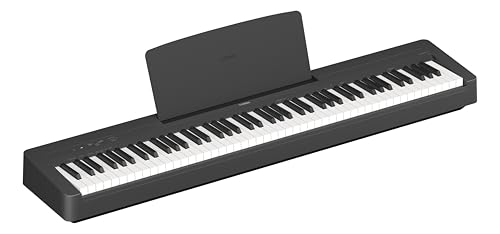
Yamaha P-145BT
The Yamaha P-145BT is the runner-up, and the model to choose when wireless connection to lesson apps is the priority. As stated on the Amazon listing, it has 88 weighted keys, Bluetooth, and built-in speakers, and a sustain foot switch and a music rest are included. The weighted keyboard gives students the graded resistance they need for technique work, while the speakers mean the piano can be played and heard without any external equipment at all.
Bluetooth changes the lesson routine in small but real ways. A student following an app-based course, playing along with a teacher’s backing track, or using a tablet for sheet music and exercises can connect without running a cable across the room. In a home where the piano shares space with everything else, one fewer cable is one fewer thing to trip over, unplug or lose. For families whose lessons already run through a phone or tablet, the P-145BT fits that workflow directly.
Like the P-225B above, the P-145BT is a slab-style portable: it needs a stand or a suitable table, and it is light enough to be moved by one person and stored against a wall or under a bed when the room is needed for something else. The included sustain foot switch covers the first pedal work a beginner meets, and the music rest holds books and printed exercises at a readable angle.
The built-in speakers are easy to overlook in a specification list, but for lessons they settle a practical question: the piano can simply be switched on and played, with nothing else to connect, position or power. A teacher visiting the home, or a parent sitting in on practice, hears the same sound the student hears, at a volume that fills a room without overwhelming it. And when practice needs to be quiet, a student can work through headphones while the rest of the household carries on, which is often what makes evening practice possible at all. An instrument that asks for no extra equipment lowers the barrier to the short, frequent practice sessions that teachers ask for between lessons.
Where the P-145BT gives ground to the P-225B is in the headline figures recorded from its listing: the prep for this guide did not record a polyphony count or a voice count for this model, so a buyer comparing those numbers directly should confirm them on the product page before ordering. What the listing does establish is the combination that defines the model: weighted keys, Bluetooth, speakers, and the two accessories in the box.
Specs
– Model: Yamaha P-145BT
– Keys: 88 weighted keys
– Connectivity: Bluetooth
– Speakers: built in
– Included: sustain foot switch and music rest
Pros
– Bluetooth for cable-free connection to lesson apps and tablets
– Built-in speakers, so it plays anywhere with a power outlet
– Sustain foot switch and music rest included
Cons
– Polyphony and voice figures were not recorded from the listing checked for this guide, so confirm them on the product page
– Fewer headline features than the P-225B for buyers who do not need Bluetooth
Yamaha P-45B
The Yamaha P-45B is the established, simpler option in this guide, and for many lesson situations simple is exactly right. As stated on the Amazon listing, it has GHS 88 weighted keys, 10 voices, 64-note polyphony, amplifiers rated at 2 x 6W, and USB-MIDI, at a weight of about 25.3 lb. It has been a common sight in teaching rooms and student bedrooms for years, which means teachers are familiar with it and accessories and stands that fit it are easy to find.
The GHS action is Yamaha’s graded hammer standard action: heavier in the low keys, lighter in the high keys, like an acoustic piano. For a beginner working through the first years of lessons, that grading is the single most important feature on the instrument, and the P-45B has it. The 10 voices cover the core sounds a lesson needs, with the piano voice doing nearly all of the work, and the built-in amplification is enough for practice and for a teacher sitting alongside.
The honest limitation is polyphony. At 64 notes, the P-45B has a third of the headroom of the P-225B. In early repertoire that rarely matters, because pieces are short and pedalling is light. As a student advances into longer pieces with sustained pedal through dense chords, notes can begin to drop. A teacher planning for several years of progress should weigh that ceiling, while a family buying for a first year or two of lessons may never reach it.
USB-MIDI lets the P-45B connect to a computer for notation software, lesson apps and MIDI recording, though unlike the P-225B it does not act as a USB audio interface, so audio recording needs a different route. At about 25.3 lb it is the heaviest model in this guide, but it is still a one-person carry and still stores flat when not in use. Note that this guide covers the standard P-45B listing; a separate Renewed variant exists under a different listing and is not the model linked here.
There is also a quieter argument for the P-45B: predictability. Because the model has been in teaching rooms for so long, a teacher can give setup and practice advice from memory, method books and online tutorials frequently assume exactly this class of instrument, and a family buying secondhand accessories such as stands will find the fit well documented. None of that appears in a specification list, but for a first piano bought with some nervousness, a model this well understood removes a layer of uncertainty. The trade is the lower polyphony and shorter feature list already described; for the first years of lessons, many households will judge that trade acceptable.
Specs
– Model: Yamaha P-45B
– Keys: 88, GHS graded hammer action
– Voices: 10
– Polyphony: 64 notes
– Amplifiers: 2 x 6W
– Weight: about 25.3 lb
– Connectivity: USB-MIDI
Pros
– GHS graded action, the key feature for building acoustic piano technique
– A long-established model that teachers know well
– USB-MIDI for lesson apps and notation software
Cons
– 64-note polyphony is the lowest in this guide and can show in advanced pedalled pieces
– Heaviest model here, at about 25.3 lb
– No USB audio interface, unlike the P-225B
How to Choose
Begin with the key action, because it is the feature a student touches in every practice session. All three models here have 88 full-size keys with graded weighting, heavier at the bass end and lighter at the treble end, which is what makes practice transfer to an acoustic piano. Any of the three satisfies that requirement; the choice between them is made on the other features.
Next, think about how lessons actually happen in the household. If lessons are in person and practice is from printed books, any of these pianos works, and the P-45B covers the basics at the simplest specification. If lessons run through apps, tablets or a computer, connection matters: the P-145BT adds Bluetooth for a cable-free link, and the P-225B adds a USB audio interface, which is the cleanest route for online lessons where the teacher needs to hear the piano clearly, and for recording practice.
Then consider polyphony against the student’s trajectory. A beginner in the first year will not trouble even a 64-note ceiling. A student heading toward intermediate repertoire with sustained pedalling will benefit from the P-225B’s 192 notes. Buying for where the student will be in two or three years is usually better value than buying only for the first term.
Finally, plan the physical setup. None of these pianos includes a stand or bench in the listings checked, so allow for a stand that holds the piano at proper playing height; a table of the wrong height teaches poor posture. All three include a sustain switch or foot switch and a music rest, so the first pedal exercises and printed music are covered from day one. Headphones, which plug into any of these, are worth adding for practice in a shared home.
One last consideration is where the piano will live between sessions: flat under a bed, upright against a wall, or left on its stand in a corner. Measure that space before choosing. The P-225B, at 11.5 kg, is the easiest of the three to move daily; the P-45B, at about 25.3 lb, is manageable but more likely to stay where it is put. A piano that lives out on its stand tends to be practised on more than one that must be fetched and assembled, so the honest answer about storage is part of the buying decision.
FAQs
Do these pianos have the same number of keys as an acoustic piano?
Yes. All three models in this guide have 88 keys, the full range of an acoustic piano, so a student will never run out of keyboard at either end while working through lesson repertoire. The keys are also weighted and graded, heavier in the bass and lighter in the treble, which is the feel a teacher expects a student to practise on.
Which of these is best for online lessons?
The Yamaha P-225B, because its built-in USB audio interface sends the piano’s audio straight to a computer, which gives the teacher a clear signal without extra equipment. The Yamaha P-145BT is the alternative for app-based learning, since its Bluetooth connects wirelessly to a phone or tablet. The P-45B connects by USB-MIDI, which carries playing data for apps and notation software rather than audio.
How long will a beginner piano like these last a student?
Through the first several years of lessons, in most cases. The graded actions on all three build correct technique from the beginning, so there is no need to upgrade for key feel early on. The point where an advancing student may outgrow a model is polyphony and sound refinement: the P-45B’s 64-note ceiling can show in advanced pedalled pieces, while the P-225B’s 192-note polyphony leaves considerably more room to grow.
Conclusion
For most students, the Yamaha P-225B is the top pick: the graded GHC action, 192-note polyphony, 24 voices and USB audio interface cover in-person and online lessons alike, in the lightest body in this guide at 11.5 kg. The Yamaha P-145BT is the runner-up for households whose lessons run through apps and tablets, thanks to its Bluetooth connection. The Yamaha P-45B remains the straightforward, proven choice for the first years of lessons, with the same full-size graded keyboard and a simpler specification. Whichever model is chosen, add a stand at proper playing height, and confirm the current listing details on the product page before ordering.