Key takeaways
- Riding with hemorrhoids calls for a wide, supportive saddle and a pressure-relief channel. Compare comfort seat shapes, setup tips and riding habits here.
If sitting on a standard bicycle saddle has become something you dread, the problem is usually geometry rather than toughness. A narrow racing saddle concentrates your weight on a small area of soft tissue. A comfort saddle takes the opposite approach: it supports you on the sit bones, spreads the load across a wider platform, and uses a central channel or cutout to take pressure off the tissue between them. This guide explains which shapes help and why, covers three wide comfort saddles worth considering, and gives the setup and riding-habit changes that matter as much as the saddle itself. It is a guide to comfort equipment, not medical advice; persistent pain or symptoms are a conversation for a clinician, not a product page.

Disclosure: As an Amazon Associate, this site may earn from qualifying purchases made through links in this article, at no additional cost to you.
Why Saddle Shape Matters More Than Padding
The instinctive fix for a sore seat is more padding, and it is mostly wrong. Very soft, deep padding lets the sit bones sink in, which pushes the surrounding foam up into the soft tissue between them and increases pressure exactly where you least want it. What works is support in the right places: a platform wide enough that your sit bones land on the saddle rather than inside it, a shape that holds you on those bones, and a relief channel down the middle so the central tissue carries as little load as possible.
Width is therefore the first specification to check, and it must be matched to you rather than to marketing. Sit bones vary, and many bike shops will measure their spacing on a simple pressure pad in a minute. As a rule, riders who are uncomfortable on standard saddles do well on the wide comfort class covered here, roughly ten inches and more across the rear, sitting upright. The more upright your riding position, the wider the saddle you need, because upright posture puts more weight through the seat and less through your hands and feet.
CDYWD Oversized Comfort Seat: The Widest Platform Here
The CDYWD oversized bike seat (ASIN: B0BFXMW9Z5) is the broadest option in this guide, at roughly twelve by thirteen inches, with a thick padded top, a wide rear platform shaped to take sit-bone weight, and suspension elements underneath to take the sting out of potholes and cracked pavement. It is aimed squarely at upright riding: cruisers, hybrids, city bikes and exercise bikes, where the rider sits tall and the seat carries most of the load. For a rider whose current saddle feels like a fence rail, this is the shape that most completely changes the experience, because the weight moves from soft tissue to bone, where the body is built to carry it.
The trade-offs of the very wide class are real and worth knowing. A seat this broad can brush the backs of the thighs on each pedal stroke for some riders, and it suits an upright, moderate-cadence style rather than athletic riding. Within its intended use, though, it is the strongest answer here to the specific problem in the keyword: maximum support, maximum spread of load, minimum central pressure.
YLG Oversized Comfort Seat: Wide, Sprung and Cushioned
The YLG oversized comfort seat (ASIN: B07QHTZHXD) takes the same wide-platform approach at roughly ten and a half inches across, with memory foam padding and dual springs beneath the rear. The slightly narrower body than the CDYWD makes it a useful middle step for riders who found a standard saddle unbearable but do not want the full cruiser platform, and the springs add genuine shock absorption on rough city streets. It fits the same upright family of bikes and the same kind of rider.
A note on availability for this class of seat, stated plainly: listings for these oversized saddles have an inconsistent record, with older listing snapshots sometimes showing no buying option while current roundups continue to treat the seats as live products. Confirm that the listing in front of you shows a live buying option for this ASIN before ordering, and if it does not, the Bikeroo below is the fallback in the same shape family.
Bikeroo Wide Cruiser Saddle: The Established Alternative
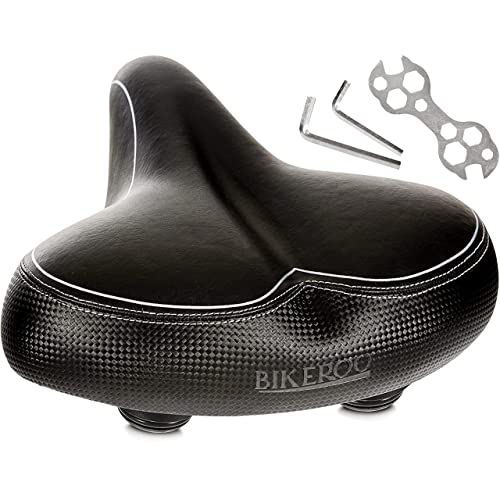
The Bikeroo wide cruiser saddle (ASIN: B07B646ZZY) is a long-running name in this category, built around memory foam padding with spring or elastomer suspension depending on the version, a wide rear platform rated by its maker for heavier riders, and a shape intended for upright cruising and exercise-bike use. It has been sold in this form for years, which counts for something in a category full of short-lived listings: the design is proven, the mounting is standard, and replacement is straightforward if the first one wears.
Between the three, the choice is one of degree. The CDYWD is the widest and most supportive, the YLG splits the difference with its spring pair, and the Bikeroo is the conservative, established option. All three attack the problem the same way, with width, sit-bone support and central relief, and any of them is a categorical improvement over a narrow saddle for a rider in discomfort.
Setup: Where Most Comfort Is Won or Lost
A comfort saddle installed badly will still hurt, so treat setup as part of the purchase. Start with the saddle level, measured with a phone level app on the top surface; a nose tilted down slides you forward onto soft tissue, and a nose tilted up presses into it. Set the height so your knee keeps a soft bend at the bottom of the stroke, because a saddle set too high makes you rock side to side, grinding tissue against the seat with every pedal revolution. Move the saddle on its rails so your weight sits over the wide rear platform rather than perched on the narrow middle.
Give a new saddle a fair trial of several rides before judging it, but judge it honestly: numbness or sharp pain is never something to push through, and if a wide, level, correctly positioned saddle still leaves you in real discomfort, that is information to take to a medical professional rather than to another product listing.
Riding Habits That Help
Equipment is half the answer; habits are the other half. Stand on the pedals for a few seconds every few minutes on longer rides to restore circulation. Wear padded cycling shorts or a padded liner under ordinary clothing, because a chamois spreads load and manages friction in a way ordinary fabric does not. Build ride length gradually after a saddle change rather than testing a new seat on your longest route. Keep rides shorter and more frequent while you adapt. And pay attention to the unglamorous basics: a saddle that suits you, on a bike that fits you, ridden with regular standing breaks, is a combination that solves the problem for most riders who do not have an underlying condition needing treatment.
What to Avoid
Avoid gel covers that slip over an existing narrow saddle; they add unstable padding without adding width or support, and they tend to bunch and wander. Avoid very narrow saddles marketed on weight, and be skeptical of any product that promises to cure a medical condition, because saddles do not do that and honest ones do not claim to. Finally, avoid judging a comfort saddle in the first five minutes in a parking lot: these seats prove themselves at minute forty, not minute four.
Materials and Suspension: What the Descriptions Mean
Comfort saddles are built a few different ways, and the vocabulary is worth decoding. Memory foam padding shapes itself to the rider and is the commonest choice in this class; it suits steady, upright riding well. Gel padding feels plush in the hand but can feel less supportive over a long ride, because it displaces sideways under load rather than holding the sit bones up. Underneath, steel coil springs are the traditional suspension and genuinely absorb sharp shocks from potholes and kerbs, at the cost of weight and a slight bounce some riders notice when pedalling fast. Elastomer bumpers are lighter and calmer, with less travel. None of these is a wrong answer; they are flavours of the same strategy, and the wide platform does more for comfort than the choice between them.
The base and rails matter for fitting rather than feel. All three saddles here use standard twin-rail mounting that fits the seatpost clamp on the overwhelming majority of bikes, so installation is a two-bolt job and the saddle can move fore and aft on its rails for position. Check that your seatpost clamp is the common twin-rail type before ordering anything, because a small minority of posts use proprietary fittings.
When Position Helps More Than Padding
Sometimes the saddle is innocent and the riding position is the culprit. A handlebar set very low forces weight forward and rotates the pelvis, loading tissue that an upright posture would spare. Raising the bar with a taller stem or a riser, which is inexpensive and reversible, moves weight back onto the sit bones where a comfort saddle can do its work. A bike set up for an athletic crouch will fight any saddle you fit to it, so if your discomfort began with a new bike or a changed stem, look there first. Equally, a saddle set too far forward puts you on the narrow part of even the widest seat. The wide platform only works if you are actually sitting on it, so slide the saddle on its rails until your weight lands on the broad rear section, and re-check after the first rides as the padding settles.
A Final Word on Expectations
A comfort saddle changes the pressure map of sitting on a bicycle, and for most riders whose problem is equipment rather than health, that change is the difference between avoiding the bike and enjoying it. It does not work instantly for everyone, because tissue that has been aggravated needs calm rides while it settles, and it does not replace medical care where care is needed. Set the expectation at steady improvement over the first few weeks of shorter, regular rides, and judge the experiment at the end of that period rather than the end of the first afternoon.
The Bottom Line
For a rider whose standard saddle has become a barrier to riding at all, a wide comfort saddle that supports the sit bones and relieves the centre is the single most effective equipment change available. The CDYWD gives the broadest platform, the YLG a slightly trimmer sprung alternative with an availability check advised, and the Bikeroo the established fallback. Fit it level, set the height with care, stand regularly, and build distance gradually. If discomfort persists despite all of that, treat it as a health question rather than a shopping question and get it looked at properly.