Key takeaways
- Find the best base-station VR trackers for social VR, from full-body VRChat rigs to spare pucks, with SteamVR Lighthouse tracking and battery life compared.
In social VR, your avatar only feels alive when your body moves the way you do, and that is exactly what a base-station tracker adds. Headset and hand tracking alone leave your hips, feet and torso frozen or guessed at by software, so dancers drift and sitters float. The real decision is which generation to buy and how many you need, because every option here depends on SteamVR base stations you must already own or buy separately, plus a PC running SteamVR and a free USB port per tracker dongle.


This guide is for VRChat regulars building a first full-body rig, VTubers and dancers who spend long evenings in social worlds, and anyone replacing a broken puck. The three picks below were chosen from the name and specifications shown on their Amazon listings: the current HTC VIVE Tracker 3.0 as a single unit, a three-pack of the same tracker bundled with a belt and straps, and the older 2018 tracker for spare or budget builds.
Quick Picks
As an Amazon Associate we earn from qualifying purchases.
| Product | Best for | Key spec from title |
|---|---|---|
| HTC VIVE Tracker (3.0) | Adding one tracking point to an existing Lighthouse room | SteamVR BS1.0 and BS2.0 support |
| HTC 3 Pack VIVE Tracker (3.0) with Rebuff Reality TrackBelt + 2 TrackStraps | Starting a complete three-point full-body rig in one order | Three Tracker 3.0 units with TrackBelt |
| HTC VIVE Virtual Reality System Tracker 2018 | Replacing a lost puck or building a spare set | SteamVR Base Station 1.0 and 2.0 support |
How to Choose
Base station generation and room coverage
Every tracker in this guide is located by lasers from external base stations, so your room setup decides how well any of them performs. SteamVR Base Station 1.0 units work with all three picks, while Base Station 2.0 units widen the tracked area and let you run up to four stations for a larger play space. Two stations cover a typical bedroom-sized area, and occlusion is the enemy: a tracker hidden behind your own body or furniture drops out until a station sees it again. Before ordering trackers, confirm which generation your stations are, mount them high in opposite corners, and measure the space, because a third station often fixes more tracking gaps than a fourth tracker ever will.
How many trackers you actually need
Full-body tracking in VRChat starts with three trackers, one on each foot and one on the hip, and that trio is what most social VR users should plan around. A fourth tracker on the chest steadies your torso when you sit, lie down or lean, and extra trackers on knees or elbows only matter for dance, motion capture or detailed roleplay. Each tracker pairs through its own USB dongle, so count the free USB ports on your PC before you buy, and remember that a hub can help with ports but does not remove the one-dongle-per-tracker rule. Buying a single puck first is sensible if you are unsure, since you can add matching trackers later.
Weight, battery life and comfort across long sessions
Social VR sessions run for hours, so a tracker that drags on a strap or dies mid-event ruins the evening. The Tracker 3.0 weighs 75 grams and runs for up to 7.5 hours, which covers an entire night of dancing or hanging out without a mid-session charge. The 2018 tracker is heavier at 89 grams with a shorter battery life of around 4 hours, a difference you feel on your feet after the first hour. Straps matter just as much as the hardware: a belt that slips lets the hip tracker wander, and a foot strap that rotates makes your avatar’s feet point the wrong way, so budget for proper straps if your pick does not include them.
Headset and platform compatibility
These are SteamVR trackers, which means they belong to a PC VR ecosystem and need SteamVR running on a computer with base stations in the room. They work with the HTC VIVE, VIVE Pro series, VIVE Pro Eye series and VIVE Cosmos Elite when base stations are in use, and with other Lighthouse headsets such as the Valve Index. Standalone headsets do not support them natively, so Quest owners need extra calibration software and a PC to bridge the two systems, a setup that takes patience and research. Check the compatibility list on the listing before ordering, and confirm your social VR app supports SteamVR full-body tracking.
The 3 Best Options
HTC VIVE Tracker (3.0)
This is the standard single puck that most Lighthouse rooms are built around, and it suits anyone who already owns base stations and wants to add or replace one tracking point. At 75 grams with a 7.5-hour battery, it is light enough to wear on a foot or hip for a full evening, and its 240-degree field of view keeps it visible to the base stations through twists, reaches and spins. The box includes the tracker, a USB dongle, a USB-C dongle cradle and a USB-C cable, so it pairs as soon as you have a free USB port.
Specs
- Full-body tracking with as few as 3 trackers
- Support for SteamVR BS1.0 and BS2.0
- Field of view: 240 degrees
- Weight: 75g, 15 percent lighter than VIVE Tracker (2018)
- Battery life: 7.5 hours, up to 75 percent longer than VIVE Tracker (2018)
- In the box: VIVE Tracker (3.0), dongle, dongle cradle (USB-C), USB cable (USB-C)
- USB port can input controller button events in addition to providing power
- Requires base stations and software, sold separately
- Compatible with HTC VIVE (Base Station only), VIVE Pro Series, VIVE Pro Eye Series, VIVE Cosmos Elite, and VIVE Cosmos External Tracking Faceplate when using Base Station or SteamVR Base Station 2.0
Best for: Adding a single tracking point to a Lighthouse room you already use for VRChat or VTubing.
Watch out for: Straps are not included, so order a belt and foot straps separately, and confirm you have a free USB port for the dongle.
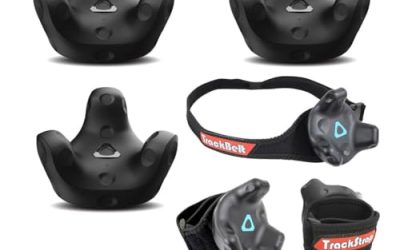
HTC 3 Pack VIVE Tracker (3.0) with Rebuff Reality TrackBelt + 2 TrackStraps
This bundle is the fastest route from zero trackers to a working full-body rig, because it puts three Tracker 3.0 units, a TrackBelt and two TrackStraps in a single order. Each puck carries the same 3.0 specifications as the single unit, with 75-gram weight, 7.5-hour battery life and 240-degree field of view, so the hips and both feet all get the current generation hardware at once. The included belt and straps remove the most common first-timer mistake: receiving trackers with nothing to attach them to your body. For VRChat dancers and first-time full-body users, this kit skips the separate strap hunt and gets your whole avatar moving.
Specs
- Three HTC VIVE Tracker (3.0) units included
- Includes Rebuff Reality TrackBelt and 2 TrackStraps
- Support for SteamVR BS1.0 and BS2.0
- Field of view: 240 degrees
- Weight: 75g per tracker
- Battery life: 7.5 hours per tracker
- In the box per tracker: VIVE Tracker (3.0), dongle, dongle cradle (USB-C), USB cable (USB-C)
- Requires base stations and software, sold separately
- Full-body tracking with as few as 3 trackers
Best for: Building a complete three-point VRChat full-body setup in one order, with straps included.
Watch out for: Three trackers need three free USB ports for their dongles, and base stations are still sold separately, so check both before ordering.
HTC VIVE Virtual Reality System Tracker 2018

The 2018 tracker is the previous generation puck, and it earns its place as a spare, a replacement or the core of a lower-cost rig. It tracks through the same SteamVR Base Station 1.0 and 2.0 system as the 3.0, mounts with the same 1/4-inch UNC threaded mount, and works with the same headsets, so it slots into an existing room without changing anything else. The trade-offs are concrete: at 89 grams it is heavier than the 3.0, its battery lasts around 4 hours instead of 7.5, and it charges over micro-USB rather than USB-C. For a backup puck or a prop tracker, those limits rarely matter.
Specs
- Support for SteamVR Base Station 1.0 and 2.0
- Dimensions: 99.65mm diameter x 42.27mm
- Weight: 89g
- Battery life: 4 hours
- Charging: Micro-USB
- Input: Pogo pin
- Attachment: 1/4-inch UNC threaded mount (standard tripod mount)
- Status indicator: LED
- 1 Lithium Polymer battery included
- Base stations sold separately
Best for: Replacing a broken tracker or building a spare set without paying for the newest generation.
Watch out for: Battery life is much shorter than the 3.0, so charge it between sessions and keep a micro-USB cable handy, since it does not use USB-C.
Which One Fits Your Situation
Starting full-body tracking in VRChat from scratch
Choose the HTC 3 Pack VIVE Tracker (3.0) with Rebuff Reality TrackBelt + 2 TrackStraps. Three pucks cover the standard hips-and-feet layout, the belt and straps are already in the box, and every tracker shares the same 7.5-hour battery and 240-degree field of view. You still need two base stations and a SteamVR PC, but the tracking hardware itself arrives complete.
Adding one more tracking point to a working rig
Choose the single HTC VIVE Tracker (3.0). It matches the generation most current rigs already use, so it pairs cleanly with your existing pucks, and its light weight and long battery make it ideal for a chest tracker that steadies your torso when you sit or lie down. Just confirm a free USB port for its dongle first.
Replacing a lost or broken puck on a budget
Choose the HTC VIVE Virtual Reality System Tracker 2018. It uses the same base stations, the same mount and the same SteamVR pairing as the newer model, so it drops into your existing setup without new accessories. Accept the shorter battery life and micro-USB charging as the price of a cheaper spare.
Attaching a tracker to a prop or camera for motion capture
Choose the single HTC VIVE Tracker (3.0). Its 1/4-inch UNC threaded mount screws onto standard tripod hardware, its 75-gram weight barely changes the balance of a prop, and the 7.5-hour battery outlasts a long capture session. The 240-degree field of view also helps when the prop turns away from one base station.
Common Mistakes
- Buying trackers before owning base stations, since a Lighthouse tracker cannot locate itself without them and does nothing on its own.
- Ordering single trackers and forgetting straps, leaving new pucks with no way to attach to feet, hips or chest.
- Running out of USB ports, because every tracker needs its own dongle connected to the PC at the same time.
- Assuming a standalone Quest headset will use these trackers directly, when they need a PC, SteamVR and extra calibration software to work together.
- Mixing tracker generations without checking battery and charging differences, so one puck dies hours before the others mid-session.
Frequently Asked Questions
How many trackers do I need for full-body tracking in VRChat?
Three trackers cover the standard full-body layout, with one on each foot and one on the hip, the setup most VRChat users start with. A fourth tracker on the chest improves how your torso behaves when you sit, lie down or lean, while knee or elbow trackers suit dance and motion capture. Each tracker needs its own USB dongle, so count free ports before adding more.
Do base-station trackers work with a Meta Quest headset?
Not on their own, because these trackers belong to the SteamVR Lighthouse system and need base stations plus a PC running SteamVR. Quest owners can bridge the two systems with community calibration software, which aligns the Quest headset space with the Lighthouse space, but it takes setup time and troubleshooting. If you play only standalone Quest games, a Lighthouse tracker is the wrong purchase.
What is the difference between the Tracker 3.0 and the 2018 tracker?
The Tracker 3.0 is smaller, lighter and longer lasting, at 75 grams with a 7.5-hour battery and USB-C charging, against 89 grams, around 4 hours and micro-USB on the 2018 model. Both support SteamVR Base Station 1.0 and 2.0, share the 1/4-inch UNC mount and work with the same headsets. The 3.0 also widens the field of view to 240 degrees.
Do I need anything else besides the trackers?
Yes, several things. You need at least two SteamVR base stations mounted in the room, a PC running SteamVR, a free USB port per tracker dongle, and straps to wear the trackers on your body. Single trackers ship without straps, so a belt and foot straps are essential extras. Headset compatibility also matters, so check that your headset works with base stations before ordering.