Our Short List of 3
- Best for: Renters and homeowners who want one tidy gate for a doorway, hallway or bottom-of-stairs gap.
- Overall dimensions: 60.5 x 0.75 x 31.5 inches
- Item weight: 25 pounds
- Model number: SKY5549
- Door: Swing door with safety lock

- Best for: Wide, angled or irregular spaces where a single fixed gate cannot reach or turn.
- Overall dimensions: 144 x 0.8 x 32 inches
- Item weight: 34.4 pounds
- Panels: 6
- Door: Lockable walk-through door

- Best for: Small dogs, and homes where the same gate moves between openings of different widths.
- Fits openings: 34 to 63 inches wide
- Height: 32 inches
- Item weight: 16.7 pounds
- Model number: 94193
All 3 Picks at a Glance
| Product | Specs | Action |
|---|---|---|
| Best Choice Products 3-Panel Freestanding Pet Gate with Walk Through Door, Espresso |
| Check price on Amazon |
| PAWLAND Extra Wide Dog Gate with Door Walk Through, 6 Panels, White |
| Check price on Amazon |
| Richell Premium Plus Freestanding Pet Gate with Door |
| Check price on Amazon |
Key takeaways
- Three freestanding pet gates that are also walk-through designs, compared on panel span, height, door locking and support feet from their Amazon listings.
A freestanding pet gate solves a specific problem: you want a doorway or hallway blocked off without drilling into walls, pressure-mounting against trim, or giving up the opening entirely. The walk-through part matters just as much. A gate you have to step over or drag aside every time you pass will end up left open, and an open gate contains nothing. The useful design is a self-supporting barrier with a real hinged door built into it.
This guide is for dog and cat owners in rentals, open-plan homes and houses with wide openings that standard pressure gates cannot span. Every gate below is freestanding, meaning it stands on its own feet or panel geometry, and every one has a lockable walk-through door listed as part of the product. Widths, heights and weights are taken from each product’s Amazon listing.
Quick Picks
As an Amazon Associate we earn from qualifying purchases.
| Product | Best for | Key spec from title |
|---|---|---|
| Best Choice Products 3-Panel Freestanding Pet Gate, Espresso | Everyday doorways and hallways | 31.5 in tall, walk through door |
| PAWLAND Extra Wide Dog Gate with Door, 6 Panels | Wide and irregular openings | 144 in wide, 30 in tall |
| Richell Premium Plus Freestanding Pet Gate with Door | Small dogs and adjustable fits | Fits 34 to 63 in openings, 32 in tall |
How to Choose
Freestanding stability comes from feet and panel angles
A freestanding gate has no wall to lean on, so its stability is mechanical. Look for support feet that extend front and back, or for panels that can be angled into a zigzag, because a straight line of panels across a wide opening is the easiest arrangement for a dog to push over. Listings that mention support feet, double hinges or adjustable side panels are describing exactly this. The heavier the gate, the harder it is to shift, but weight alone is not the answer: a well-braced lighter gate often stands firmer than a heavy one balanced on a narrow base.
The door needs a lock a dog cannot work
The walk-through door is the feature you will use dozens of times a day, so judge it as hardware, not decoration. A simple lift-latch that a clever nose can nudge open defeats the purpose, while a door with a positive safety lock, ideally one that swings both ways and latches at top or bottom, keeps the barrier honest. Check the listing for how the door opens and locks, and whether the door is wide enough for a person carrying shopping or a laundry basket to pass through without turning sideways.
Height and span must match your dog and your opening
Measure the opening first, then think about the dog. A gate that spans the gap on paper but leaves the panels at extreme angles loses stability, so choose a configuration with some adjustment in reserve. Height is about jumping and leaning rather than breed labels: a gate around 30 to 32 inches tall suits most small and medium dogs, while determined jumpers and large breeds need the barrier effect to come from placement and training as much as from inches. Note any pet weight guidance in the listing, since some freestanding designs are intended for smaller animals only.
Panel systems trade tidiness for flexibility
Fixed three-panel gates fold flat and look like furniture, which suits a single doorway you block every day. Longer multi-panel systems can turn corners, close off a fireplace or divide a room, and some can be reconfigured as a playpen-style enclosure. The trade-off is storage and setup time: more panels mean more hinges to align and a bulkier bundle to put away. Decide whether you are solving one permanent gap or several changing ones, because that answer points to very different products even though both are sold as freestanding gates.
The 3 Best Options
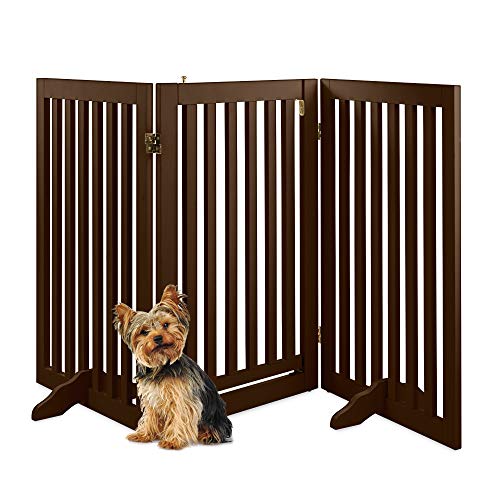
Best Choice Products 3-Panel Freestanding Pet Gate with Walk Through Door, Espresso
- Best for: Renters and homeowners who want one tidy gate for a doorway, hallway or bottom-of-stairs gap.
- Overall dimensions: 60.5 x 0.75 x 31.5 inches
- Item weight: 25 pounds
- Model number: SKY5549
- Door: Swing door with safety lock
Renters and homeowners who want one tidy gate for a doorway, hallway or bottom-of-stairs gap.
The 60.5-inch total span is fixed by its three panels, so wider or sharply angled openings need a configurable panel system instead.
This three-panel wooden gate is the straightforward pick for a standard doorway or hallway. The middle section carries a swing door with a safety lock, so people pass through properly instead of stepping over, and the support feet at the base keep the unit standing without any wall fixing. The 360-degree double hinges let the panels fold in either direction, which helps when the gate needs to sit at an angle in a corner or fold flat against a wall between uses. At 25 pounds it is heavy enough to feel planted, yet still easy to move from room to room.
PAWLAND Extra Wide Dog Gate with Door Walk Through, 6 Panels, White
- Best for: Wide, angled or irregular spaces where a single fixed gate cannot reach or turn.
- Overall dimensions: 144 x 0.8 x 32 inches
- Item weight: 34.4 pounds
- Panels: 6
- Door: Lockable walk-through door
Wide, angled or irregular spaces where a single fixed gate cannot reach or turn.
Six panels take longer to position well, and the white finish shows muddy paw marks sooner than darker wood tones.
Six panels and 144 inches of total width make this the answer for openings that defeat ordinary gates: wide archways, open-plan divides, fireplace surrounds and L-shaped corners. The gate stands freestanding on its own support feet, the panels connect with 360-degree hinges so the run can bend around obstacles, and one panel carries a lockable walk-through door so the barrier never has to be dismantled for people to pass. At 30 inches tall it suits most dogs, and the whole run folds down when the space needs to be fully open again.
Richell Premium Plus Freestanding Pet Gate with Door
- Best for: Small dogs, and homes where the same gate moves between openings of different widths.
- Fits openings: 34 to 63 inches wide
- Height: 32 inches
- Item weight: 16.7 pounds
- Model number: 94193
Small dogs, and homes where the same gate moves between openings of different widths.
The 33-pound pet guidance is a real limit, so medium and large dogs that lean or push should use a heavier gate.
Richell designs for smaller dogs, and this gate is explicit about it, with a recommended limit of 33 pounds for the pet. Within that brief it is the most adjustable option here: it fits openings from 34 to 63 inches wide, the side panels adjust in 10-degree increments to brace the gate at the angle your room needs, and the walk-thru door opens in both directions with upper and lower locking. At 32 inches tall and under 17 pounds, it is also the easiest of the three to carry between rooms or store flat.
Which One Fits Your Situation
You rent and cannot drill or mark the walls
All three gates here stand without fixings, but the Best Choice Products gate is the natural rental pick for a single doorway: support feet, a proper door and a furniture-like espresso finish that does not make a hallway look like a kennel. Because nothing touches the walls or trim, it leaves no trace when you move out, and it folds away flat for storage between uses or at the end of a tenancy.
You need to close off a wide or oddly shaped space
Choose the PAWLAND six-panel gate. Its 144 inches of hinged panels can run straight, bend around a fireplace or turn a corner, and the support feet keep a long run upright. The lockable door matters even more at this scale, because dismantling a six-panel barrier every time someone needs to pass guarantees it will be left folded in a corner instead of doing its job.
Your dog is small but the doorway is not standard
The Richell Premium Plus fits openings from 34 to 63 inches and braces itself with side panels that adjust in small increments, which suits older houses with uneven door frames and non-standard gaps. It is built for pets under 33 pounds, so it works best where the dog respects a barrier rather than testing it, and its light weight makes it the easiest to move for cleaning or guests.
The gate will move around the house all day
Pick the Richell for portability. At 16.7 pounds it is roughly half the weight of the PAWLAND and noticeably lighter than the Best Choice Products gate, and the both-ways door with two locking points stays convenient whichever side you approach from. If the moving is between two fixed spots of similar width, the Best Choice Products gate is the sturdier-feeling alternative.
Common Mistakes
- Buying by opening width alone and ignoring how panel angles affect stability at that span.
- Choosing a gate with a door that only latches loosely, then blaming the dog for learning to open it.
- Using a gate rated for small pets against a large dog that leans its full weight on the top rail.
- Placing a freestanding gate on a slippery floor without checking that the feet grip, so the whole unit slides.
- Stepping over a gateless section out of habit and teaching the dog that the barrier is optional.
Frequently Asked Questions
Will a freestanding gate stay up if my dog jumps against it?
It depends on the dog and the setup. Support feet, angled panels and the gate’s own weight all resist tipping, and the listings here describe those features rather than promising containment for determined jumpers. A large dog that launches at barriers needs training and possibly a fixed gate; freestanding designs are barriers for dogs that respect them, which is most dogs once the boundary is consistent.
Can these gates be used at the top of stairs?
Freestanding gates are generally not the right choice for the top of a staircase, because a gate that can be pushed or tipped should never be the only thing between a child or pet and a fall. Hardware-mounted gates exist for that job. Use the gates in this guide for doorways, hallways, room divides and the bottom of stairs, where a shift in position is an inconvenience rather than a hazard.
How do I measure my opening for a panel gate?
Measure the full width of the gap at floor level, then add the angles: if the gate must turn a corner or sit in a zigzag for stability, the usable straight-line span is shorter than the total panel length. Compare that working span against the fit range in the listing, such as the Richell’s 34 to 63 inches, and leave some adjustment in reserve rather than buying a gate that only just reaches at full stretch.
Do the doors on these gates lock, or just latch?
Each gate here has a locking door rather than a simple flap: the Best Choice Products gate uses a swing door with a safety lock, the PAWLAND door is lockable, and the Richell door locks at upper and lower points and opens in both directions. A lock matters because many dogs learn within days to lift a plain latch with a nose or paw, at which point the gate is decoration.