Our Short List of 3
All 3 Picks at a Glance
| Product | Specs | Action |
|---|---|---|
 1. XS Power D3400 — best high-output starting battery | Check price on Amazon | |
 2. Odyssey 34-PC1500T — best for long service life | Check price on Amazon | |
 4. Interstate MTX-94R/H7 — best for large vehicles in the H7 case | Check price on Amazon |
Key takeaways
- Find the best reliable auto battery with four AGM picks compared by group size, cold cranking amps, reserve capacity and warranty, plus a fitment and care guide.
As an Amazon Associate we earn from qualifying purchases.
Affiliate Disclosure: This article contains affiliate links. If you buy through a link on this page, we may earn a commission at no extra cost to you. Product specifications are taken from the manufacturer and retailer listings cited for each pick, and we do not claim to have personally tested any battery in this guide.
A reliable auto battery is not the one with the biggest number on the label. It is the one that fits your tray exactly, turns the starter over briskly on the coldest morning of the year, holds its charge while the car sits, and keeps doing that for years instead of months. Reliability is mostly a matching problem: the right group size, enough cold cranking amps for your engine and climate, enough reserve capacity for your electrical loads, and a construction type that suits how the car is actually used.
This guide compares four sealed AGM (absorbed glass mat) car, truck and SUV batteries that are widely listed on Amazon US and that cover the most common reliability use cases: a high-output starting battery, a long-life heavy-duty battery, a dual-purpose battery for accessory-heavy vehicles, and a large-format battery for big vehicles. Every pick is the same product type — a 12-volt automotive starting battery — so the comparison stays honest. Prices are not quoted here because they change; judge each pick on fitment, cranking figures, reserve capacity and warranty, and confirm the listing details before you order.
Quick comparison
| Pick | Group size | Cold cranking amps | Reserve capacity | Best for |
|---|---|---|---|---|
| XS Power D3400 | 34 class, M6 bolt terminals | 1,000 cranking amps | Not stated on the listing | High-output starting and big electrical loads |
| Odyssey 34-PC1500T | 34 | 850 | 135 minutes | Long service life and heavy duty use |
| OPTIMA YellowTop D34/78 | 34/78, dual terminal | 750 | 120 minutes | Starting plus deep accessory loads |
| Interstate MTX-94R/H7 | 94R (H7) | 850 | Not stated on the listing | Large cars, SUVs and trucks in the H7 case |
What reliability actually means in a car battery
Four things decide whether a battery feels reliable in daily use. The first is cranking margin. Cold cranking amps (CCA) measure how much current a battery can deliver at zero degrees Fahrenheit for thirty seconds while holding a minimum voltage. A battery that only just meets your engine’s requirement when new will fall short after two or three winters of gradual capacity loss, so a healthy margin above the vehicle maker’s minimum is the cheapest reliability you can buy.
The second is reserve capacity, stated in minutes. It describes how long a fully charged battery can run essential loads with the alternator offline. Reserve capacity is what gets you home with the headlights on after an alternator failure, and it is what keeps a car with heavy standby electronics alive between short trips.
The third is construction. All four picks here are sealed AGM designs. In an AGM battery the electrolyte is held in fiberglass mats rather than sloshing freely, which makes the battery spill-proof, more vibration resistant than a conventional flooded battery, and better able to accept charge after a deep discharge. Those traits matter for reliability because vibration and chronic undercharging are two of the most common quiet killers of car batteries.
The fourth is fitment discipline. A battery that is the wrong group size can be electrically perfect and still be unreliable in practice, because a loose hold-down lets it vibrate, a reversed terminal layout strains the cables, and a case that is too tall can foul the hood or the clamp. Check the group size on your old battery’s label before you look at anything else in this guide.
1. XS Power D3400 — best high-output starting battery
The XS Power D3400 is a sealed AGM battery from the XS Series, built for vehicles whose electrical demands go well beyond an ordinary starter circuit. The Amazon listing describes it as a 12-volt high-output AGM battery rated at 3,300 max amps, and retailer specifications for the model give 1,000 cranking amps with a 65 amp-hour capacity. Note the terminology carefully: XS Power headlines cranking amps rather than the cold cranking amps figure the other picks in this guide use, so compare this battery on its capacity and its high-output design rather than treating the numbers as directly interchangeable. It uses M6 terminal bolts instead of conventional SAE posts, a detail that matters at installation time and is covered below.
The D3400 built its reputation in high-demand vehicles, including serious car audio builds, where the battery must deliver very large current bursts repeatedly without voltage sag, and then still start the engine afterwards. Its sealed, valve-regulated AGM construction is spill-proof and vibration resistant, and it can serve as the primary starting battery in group 34 class applications as well as a high-output support battery. For a driver whose vehicle carries a powerful amplifier system, auxiliary lighting or other heavy loads and who has seen lesser batteries fade early, that output headroom is a reliability feature, not a luxury.
Choose the D3400 when output is your problem: a hard-cranking engine combined with heavy electrical demand, in a vehicle whose tray suits its group 34 class footprint. A plain commuter car with no unusual loads does not need it, and the simpler picks below will serve that car just as reliably.
Watch the terminals before anything else. The M6 threaded terminals are not SAE posts, so standard clamp cables may need post adapters to connect properly and safely; confirm what your installation requires and budget the small extra hardware into the job rather than discovering it with the old battery already out. As with every pick here, measure the tray and check the listing dimensions for your exact variant before ordering, because high-output cases in this class vary slightly between versions.
2. Odyssey 34-PC1500T — best for long service life
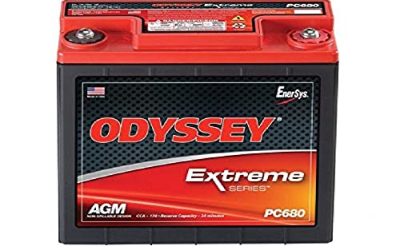
The Odyssey 34-PC1500T is a group 34 AGM battery built with thin plate pure lead plates. Because the plates are made of pure virgin lead rather than a lead alloy, the maker can fit more plates into the same case, which means more plate surface area and more power. The listing rates it at 850 cold cranking amps, and the model line is specified with a 135-minute reserve capacity and a 68 amp-hour capacity at the twenty-hour rate. It measures 10.85 by 6.76 by 7.82 inches, weighs 49.5 pounds, uses SAE top terminals, and carries a limited full replacement warranty of up to four years, the longest warranty term among these picks.
Odyssey also rates this battery for up to 400 cycles at eighty percent depth of discharge, which is deep-cycle territory that most starting batteries cannot tolerate. In plain terms, it forgives the occasional flattened-by-accident episode — lights left on, a door ajar overnight — better than a conventional starter battery, and that forgiveness is a large part of real-world reliability. Its sealed AGM construction suits trucks, SUVs and off-road vehicles that see rough roads and vibration.
The trade-offs are weight and specificity. At just under fifty pounds it is the heaviest pick in this guide, and it is a group 34 top-post battery only, with no side-terminal option, so GM side-terminal vehicles should look at the dual-terminal YellowTop pick below instead. It also rewards a healthy charging system: pure lead AGM batteries charge efficiently, but a failing alternator will shorten any battery’s life, and this one costs too much of your time and effort to waste on a car with known charging faults. Test the alternator output before you install it.
3. OPTIMA YellowTop D34/78 — best dual-purpose battery
ASIN: B000MSBUA4
The YellowTop D34/78 is OPTIMA’s dual-purpose AGM battery: it is designed both to start the engine and to survive repeated deeper discharges from electrical loads. The listing rates it at 750 cold cranking amps, with a 55 amp-hour C20 capacity and a 120-minute reserve capacity. It uses OPTIMA’s SpiralCell sealed construction, measures about 10 by 6.88 by 7.81 inches, and provides dual SAE and GM terminals for group 34 and group 78 fitments. The maker describes a free replacement warranty period for personal use; confirm the current term on the listing for your use type, because commercial terms differ.
This is the right pick when the battery’s job does not end at starting. Vehicles with winches, auxiliary lighting, power sliding doors and entertainment systems, inverters, or aftermarket audio place cycling demands on the battery every trip, and a pure starting battery asked to do that work ages quickly. The YellowTop’s 120-minute reserve capacity is the visible sign of that deeper-duty design, and it is also the better choice for vehicles without an alternator in competition use, where the battery must both crank and run the car.
The honest compromise is cranking figure: 750 CCA is lower than the Odyssey’s 850, though still strong for the group size. If your vehicle lives in a very cold climate, has a large or high-compression engine, and carries no unusual accessory load, the pure starting picks above are the more direct answer. If your vehicle does carry that load, accept the small CCA difference and take the cycling durability.
4. Interstate MTX-94R/H7 — best for large vehicles in the H7 case
The Interstate MTX-94R/H7 is the large-format pick in this guide, from one of the most established battery networks in North America. The Amazon listing describes it as a 12-volt AGM automotive replacement battery for cars, SUVs, sedans and trucks, rated at 850 cold cranking amps, 1,000 cranking amps and an 80 amp-hour capacity, in the group size 94R case, also called H7. Interstate describes its MTX absorbed glass mat line as built to meet or exceed a vehicle’s starting requirements while also powering the accessories and plug-in loads modern vehicles carry, which is precisely the combination that decides whether a big vehicle feels reliable in daily use.
That positioning suits the vehicles that take this case size. The 94R/H7 format serves larger cars and SUVs, including many start-stop applications, where the starter may fire dozens of times on a single commute while accessories keep drawing current at every stop. An AGM battery with this capacity and cranking margin, in the case the vehicle was built around, addresses the reliability problem at its source: the battery is neither undersized for the engine nor asked to work outside the construction type the charging system expects.
Interstate’s dealer and service network is the practical bonus. A battery this size is heavy, and when a warranty question or a load test comes up, being able to walk into a local Interstate dealer rather than ship the unit across the country is a real ownership advantage; confirm the current warranty terms on the listing before you buy, and keep the paperwork with the vehicle records.
Size is the warning. A 94R battery is over twelve inches long and only fits vehicles built for it; it is not a way to upgrade a smaller tray. Measure the tray, confirm the group size on the old battery, and check terminal orientation before ordering, because a reversed layout in a case this size leaves no slack to improvise with cable length. Also note that Interstate sells the MTX line in many group sizes, so make sure the listing you open is the 94R/H7 variant and not a smaller sibling with lower figures.
How to choose the right one
Start with the group size printed on your current battery or in the owner’s manual, and do not shop outside it. Then compare the CCA of each candidate with the vehicle maker’s minimum: meet it comfortably rather than exactly, especially if you live where winter temperatures fall well below freezing, because cranking demand rises as temperature drops while battery output falls.
Next, be honest about loads. A stock commuter car needs a straightforward starting battery in its correct group size. A vehicle with heavy electrical demand, from a big audio system to banks of auxiliary equipment, is the XS Power D3400’s territory. A truck with a winch, a family vehicle full of powered doors and screens, or any car that regularly runs equipment with the engine off needs the dual-purpose YellowTop pattern or the deep-cycle-tolerant Odyssey. And a large vehicle built around the 94R/H7 case needs a battery specified for that case and duty, which is the Interstate MTX-94R/H7’s role here.
Finally, read the warranty structure, not just its length. A free replacement period is worth more than a longer pro-rated period, and a warranty you can claim locally may beat a longer one that requires shipping a fifty-pound battery. Keep the receipt and record the installation date; many claims turn on documentation rather than on the battery itself.
Habits that make any battery reliable
Even the best battery dies early in a car that mistreats it. Short trips are the classic problem: a start takes a large bite of charge, and a five-minute drive does not put it all back, so the battery lives permanently undercharged and sulfates. If your pattern is short trips, a periodic longer drive or a smart maintainer charger is the single most effective reliability upgrade you can make, and it costs far less than a battery.
Keep terminals clean and tight. Corrosion adds resistance exactly where the starter needs hundreds of amps, and a loose clamp can mimic a dead battery on a cold morning. Secure the hold-down every time; vibration that an AGM tolerates better than a flooded battery still shortens life when the case can move. And when a battery does fail, test the charging system before installing its replacement, because an alternator charging at the wrong voltage will quietly destroy the new battery the same way it destroyed the old one.
Warning signs of a battery nearing the end are a starter that cranks more slowly than it used to, headlights that dim noticeably at idle, a battery that needs jump starts after sitting for a few days, and a case that is swelling or terminals that corrode again quickly after cleaning. A free load test at a parts store will usually confirm the diagnosis in minutes. Replace on your schedule when the signs appear rather than on the battery’s schedule in a parking lot.
Frequently asked questions
Is AGM always more reliable than a flooded battery? For most drivers, yes in the ways that matter day to day: AGM batteries resist vibration better, do not spill, hold charge longer in storage, and tolerate deeper discharges. A quality flooded battery in the correct group size is still a legitimate budget choice, but it needs water level checks and is less forgiving of neglect.
Can I install a higher CCA battery than my car specifies? Yes. CCA is a capability, not a dose; the starter draws what it needs. As long as the group size, terminal layout and voltage match, a higher CCA rating is safe and usually improves cold-weather reliability margin.
How long should a reliable auto battery last? Service life depends heavily on climate and use. Heat ages batteries faster than cold, though failures often appear in winter when cranking demand peaks. The picks in this guide carry multi-year warranties, and reaching or passing the warranty period is a reasonable expectation when the charging system is healthy and the battery stays charged.
Does my car need battery registration after replacement? Many newer vehicles, especially start-stop models, need the new battery registered to the car’s computer so charging adapts to it. Check your owner’s manual; skipping a required registration can shorten the new battery’s life even when the battery itself is excellent.
Bottom line
Reliability is fitment first, cranking margin second, and construction matched to your loads third. For high-output starting in a group 34 class vehicle with heavy electrical demand, the XS Power D3400 (ASIN: B005FYJ5B6) is the direct answer. For the longest service outlook and tolerance of deep discharges, choose the Odyssey 34-PC1500T (ASIN: B00249CSS2). For accessory-heavy vehicles, the OPTIMA YellowTop D34/78 (ASIN: B000MSBUA4) trades a little cranking figure for real cycling durability. And for large vehicles built around the 94R/H7 case, the Interstate MTX-94R/H7 (ASIN: B0BH8G6CSC) brings 850 cold cranking amps and an 80 amp-hour capacity from an established service network. Confirm your group size on the listing before ordering, and any of the four will give you the uneventful starts that define a reliable battery.