Key takeaways
- Compare the best stand mixers for small kitchens, from a 3-quart budget mini to a 5.5-quart die-cast model, with bowl sizes, speeds and storage notes.
A stand mixer is the hardest appliance to justify in a small kitchen. It is heavy, it is tall, and it spends most of its life sitting still, so every inch of counter it claims has to be earned back on baking day. The full-size models that dominate most roundups assume a deep counter, tall clearance under the upper cabinets, and a permanent parking spot. Apartment kitchens rarely offer any of the three.
The five mixers below were picked with that reality in mind. Two are genuinely compact machines built for small batches, one converts into a hand mixer so the stand can go back in a cupboard, and two are standard designs in their smallest sensible sizes for cooks who bake often but still need the counter back afterwards. Every pick is a countertop stand mixer, and each one lists the bowl size, speed count, and included attachments that decide the fit.
As an Amazon Associate, we earn from qualifying purchases.
Quick Answer
For most small kitchens, the KitchenAid Artisan Mini is the safest pick: a 3.5-quart tilt-head mixer with 10 speeds that can live on the counter. On a tight budget, the Dash Everyday Stand Mixer covers batters and doughs in a 3-quart bowl. If you bake bigger batches, the KitchenAid Classic Series steps up to 4.5 quarts, and the Cuisinart Precision Master offers 5.5 quarts with a 500-watt die-cast build.
What Makes a Stand Mixer Work in a Small Kitchen
Four measurements matter more than brand or color. The first is height. Most wall cabinets sit about 18 inches above the counter, and a tilt-head mixer needs extra room above that line when the head is raised to swap attachments or lift the bowl out. A mixer that fits while closed but not while open will frustrate you every single bake.
The second is footprint. Depth is usually the problem, not width: a deep mixer pushes against the backsplash and eats the front work zone where you roll dough. The third is weight. A mixer you can lift into a cupboard with one hand gets stored; a mixer that takes two hands and a grunt tends to become permanent counter clutter, which defeats the purpose in a small room.
The fourth is bowl capacity matched to batch size. A 3-quart bowl handles a single batch of cookies, one loaf, or frosting for a layer cake without sloshing. Bigger bowls earn their space only if you regularly double recipes or knead stiff dough, because an oversized bowl mixes small amounts badly: the beater skims a thin layer of batter instead of working through it. Buy the smallest bowl that covers your biggest regular batch.
The 5 Best Stand Mixers for Small Kitchens
1. KitchenAid Artisan Mini 3.5 Quart Tilt-Head Stand Mixer (Premium)

The Artisan Mini is the full KitchenAid design shrunk for small counters. It keeps the tilt-head layout, the 10-speed lever, and the metal build of the larger Artisan, but pairs them with a 3.5-quart bowl sized for one batch at a time. KitchenAid positions it for smaller batches and tighter spaces, and it accepts the same style of hub attachments as its bigger siblings, so a pasta roller or grinder bought later still fits.
For a small kitchen, the Mini’s advantage is that it can stay out. Its bowl is big enough for a standard cookie batch, a single loaf of bread dough, or mashed potatoes for a small table, and the included flex edge beater scrapes the bowl sides as it mixes, which matters in a small bowl where unmixed pockets hide easily. Empire Red is the listing color used here; the model is the KSM3316X with flex edge beater included.
Specs:
– Bowl: 3.5-quart stainless steel
– Speeds: 10
– Head style: Tilt-head
– Included: Flex edge beater, coated dough hook, 6-wire whip
– Model: KSM3316XER (Empire Red)
2. Dash Everyday Stand Mixer, 3 Quart (Budget)

The Dash Everyday is the smallest and lightest machine on this list, built for cooks who bake occasionally and store the mixer away between uses. Its 3-quart stainless steel bowl covers the everyday jobs: pancake and cake batters, cookie dough in standard batches, frosting, and whipped cream. Six speeds handle that range, and the compact tilt-head body takes up about as much counter as a toaster while it is out.
The trade-offs are honest ones. There is no attachment hub, the bowl is the smallest here, and stiff dough in quantity is beyond this class of mixer. What you get instead is a machine that fits in a cabinet, carries easily with one hand, and costs its space only on the days you bake. The Aqua listing is the one referenced here, and the set includes two beaters and two dough hooks.
Specs:
– Bowl: 3-quart stainless steel
– Speeds: 6
– Head style: Tilt-head
– Included: 2 mixer beaters, 2 dough hooks
– Model: DCSM250 series
3. Hamilton Beach Classic Stand and Hand Mixer, 4 Quart (Budget)
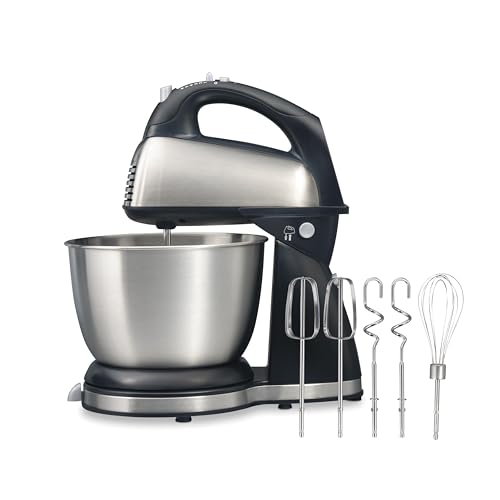
Hamilton Beach solves the storage problem differently: the mixer head detaches from the stand and works as a hand mixer, so on quick jobs the stand and bowl stay in the cupboard entirely. Locked onto its base, it is a conventional 6-speed stand mixer with a 4-quart stainless steel bowl, a size up from the two minis above and enough for most family baking.
The QuickBurst button adds a burst of power at any speed, useful when a thick batter stalls the beaters, and the Bowl Rest feature lets the hand mixer sit on the bowl edge instead of the counter during pauses. Peak power is rated at 290 watts, which suits batters, doughs of moderate stiffness, and whipping. The Black and Stainless finish is the listing used here, and five attachments are in the box.
Specs:
– Bowl: 4-quart stainless steel
– Speeds: 6, plus QuickBurst
– Peak power: 290 watts
– Design: Stand mixer with detachable hand mixer, Bowl Rest
– Included: 2 traditional beaters, 2 dough hooks, whisk
– Model: 64651 (Black and Stainless)
4. KitchenAid Classic Series 4.5 Quart Tilt-Head Stand Mixer (Mid-Range)

The Classic Series is the entry point to KitchenAid’s full-size line and the largest mixer many small kitchens can absorb. The 4.5-quart bowl handles double batches of cookies and bigger doughs than the Artisan Mini, while the tilt-head body keeps the same general footprint language as the rest of the range. Ten speeds give the same low stir for folding and high whip for egg whites that the line is known for.
Choose this one if the Mini’s bowl is your only hesitation. You give up the flex edge beater, which is not included here, and you gain capacity plus the broadest attachment and accessory ecosystem in this roundup through the front power hub. The White finish is the listing referenced, model K45SS, and the bowl, coated flat beater, coated dough hook, and 6-wire whip are included.
Specs:
– Bowl: 4.5-quart stainless steel
– Speeds: 10
– Head style: Tilt-head
– Included: Coated flat beater, coated dough hook, 6-wire whip
– Model: K45SSWH (White)
5. Cuisinart Precision Master 5.5 Quart Stand Mixer (Mid-Range)
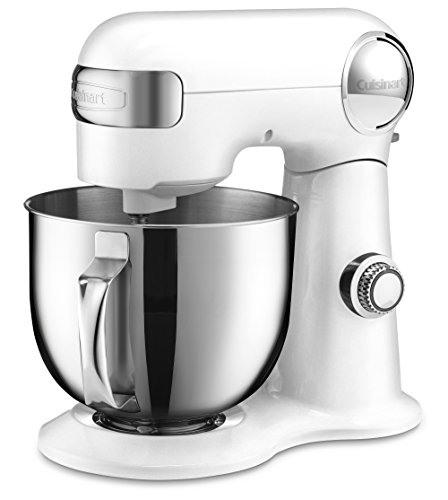
The Cuisinart Precision Master is the capacity pick, included for small kitchens where baking is a serious hobby and the mixer earns a permanent corner. Its 5.5-quart polished stainless steel bowl is the largest here, the motor is rated at 500 watts, and the die-cast metal body gives it the planted feel that keeps a mixer from walking across the counter under a heavy dough load.
Twelve speeds offer finer control than the other picks, the head tilts back for bowl access, and a power outlet on the front runs optional Cuisinart attachments such as a pasta extruder and ice cream maker. The splash guard with pour spout is genuinely useful in a small kitchen, where a flour cloud reaches every surface. White Linen is the listing color used here; the model is the SM-50, backed by a limited 3-year warranty.
Specs:
– Bowl: 5.5-quart polished stainless steel
– Motor: 500 watts
– Speeds: 12
– Construction: Die-cast metal, tilt-back head
– Included: Chef’s whisk, flat mixing paddle, dough hook, splash guard with pour spout
– Model: SM-50 (White Linen)
How to Choose a Stand Mixer for a Small Kitchen
Start with the tape measure, not the catalog. Measure the height from your counter to the underside of your wall cabinets, then check the mixer’s height with its head tilted open, not just closed. Measure depth too, and leave a few inches in front of the mixer as working room. If the numbers fail, plan where the mixer will be stored and choose a weight you can lift to that spot without a struggle.
Next, size the bowl to your real baking. One batch of cookies, one loaf, one cake: a 3 to 3.5-quart bowl is enough, and it will mix those amounts better than a big bowl does. Regular double batches or pizza dough for a family point to 4.5 quarts and up. Then look at speeds and attachments. Ten or more speeds matter if you whip egg whites or knead often; six speeds cover casual baking. Finally, decide whether an attachment hub matters to you. It is wasted money if you will never buy a pasta roller, and a genuine space saver if it replaces a second appliance.
Who Should Skip a Stand Mixer Entirely
Skip the stand mixer if you bake less than once a month: a hand mixer and a strong spoon cover cakes and batters, store in a drawer, and free the whole counter. Skip it if your kitchen has no storage spot and low cabinets, because a mixer that cannot open its head under your cabinets and cannot be put away becomes daily clutter. Dedicated bread bakers working with large, stiff, whole-grain doughs should also look elsewhere, toward a bowl-lift machine or a dedicated dough kneader, since compact tilt-head mixers are built for moderate loads.
Frequently Asked Questions
Will a 3-quart stand mixer handle a normal batch of cookie dough?
Yes. A standard cookie recipe using about 2 to 3 cups of flour fits a 3-quart bowl comfortably, and that covers most home baking sessions. You only need a larger bowl when you routinely double recipes or mix heavy doughs that climb the beater in a small bowl.
Does a tilt-head mixer fit under standard kitchen cabinets?
Usually, while closed. The check that matters is the open height: raising the head to remove the bowl adds several inches. Measure your counter-to-cabinet gap, compare it with the mixer’s open height in its listing, and if it is close, plan to pull the mixer forward before opening it.
Is a detachable hand and stand mixer as good as a dedicated stand mixer?
For batters, frostings, and light doughs, yes, and the storage advantage in a small kitchen is real. For frequent kneading or large batches, a dedicated stand mixer with a heavier body and stronger motor stays planted and works less hard, so it is the better long-term choice.
How much counter space does a compact stand mixer actually save?
The compact models here pair a smaller bowl with a shallower body, so the saving is mostly in depth and storage volume rather than width. In practice, it is the difference between a mixer that fits in a standard cabinet and one that cannot.
Final Verdict
Small kitchens reward the smallest mixer that still covers your baking. The KitchenAid Artisan Mini is the best all-round answer for most apartment cooks, the Dash Everyday wins on size and budget, and the Hamilton Beach Classic earns its place by disappearing into a cupboard as a hand mixer. Step up to the KitchenAid Classic Series or the Cuisinart Precision Master only when your batch sizes, not your ambitions, demand the bigger bowls.