Our Short List of 3

- Best for: Taller users who need the widest handle height range in this guide.
- Handle height adjusts from 45 to 52 in with locking push pins
- Forearm pads adjust forward and backward
- 8 in flat-free wheels
- Seat measures 17.5 in wide
- Best for: Outdoor walking on rough or uneven surfaces where bigger wheels matter.
- Adjustable armrest height from 38.6 to 48.4 in
- 10 in PU wheels, front and rear
- Adjustable seat height from 21.3 to 23.2 in
- Seat measures 18.5 in long by 10.6 in deep

- Best for: Outdoor trips where cushioned rubber tires and a wide seat matter most.
- Handle height adjusts from 40.9 to 46.9 in
- 10 in puncture-proof rubber front tires
- Seat measures 18.9 in wide
- Aluminium frame weighs 22.7 lb
All 4 Picks at a Glance
| Product | Specs | Action |
|---|---|---|
| Vive Mobility Upright Walker with Seat |
| Check price on Amazon |
| ELENKER All-Terrain Upright Rollator Walker |
| Check price on Amazon |
| Helavo Upright Walker with Seat |
| Check price on Amazon |
 BlessReach Heavy Duty Upright Rollator Walker |
| Check price on Amazon |
Key takeaways
- Compare 4 upright rollators with adjustable handle heights, padded armrests, seats and locking brakes to find a comfortable, steady fit for daily walking.
Choosing an upright rollator is a decision about fit first and features second. The handle height sets where your forearms rest, and a few inches in either direction changes whether you walk tall and relaxed or hunched over the frame. That is why the adjustment range matters more than any single accessory: it decides whether the rollator suits your height, your stride, and the way you naturally hold your arms.
This guide compares four upright rollators with adjustable handle heights, all sold on Amazon, for seniors and adults who want forearm support, a seat for rests, and brakes they can lock. Each model below lists its handle range, wheels, seat, and weight capacity exactly as stated on its Amazon product page, so you can match the numbers to your own height and home before you buy. If you have a medical condition that affects balance or walking, ask your doctor or physical therapist which type of walking aid fits your needs.
Quick Picks
As an Amazon Associate we earn from qualifying purchases.
| Product | Best for | Key spec from title |
|---|---|---|
| Vive Mobility Upright Walker with Seat | Tallest handle range | Handles adjust 45 to 52 in |
| ELENKER All-Terrain Upright Rollator Walker | Rough outdoor paths | 10 in PU wheels, armrests 38.6 to 48.4 in |
| Helavo Upright Walker with Seat | Cushioned rubber tires | Handles adjust 40.9 to 46.9 in |
| BlessReach Heavy Duty Upright Rollator Walker | Highest weight capacity | 450 lb capacity, 6 height adjustments |
How to Choose
Match the handle range to your height
Start with the numbers, not the photos. Every upright rollator in this guide lists a handle or armrest height range on its Amazon page, and that range decides whether the model can fit you at all. Measure from the floor to your elbow while standing in your usual shoes, then check that the number falls inside the stated range with room to spare on both ends. A range that tops out just above your elbow leaves no room to fine-tune the fit, and one that starts above it cannot come low enough. If two people of different heights will share the rollator, look for the widest range, since a shared frame needs to adjust far enough in both directions.
Decide how the forearm supports adjust
Upright rollators hold your forearms on padded supports instead of asking your hands to grip low handles, and the supports adjust in different ways. Some models move the whole armrest up and down with the handle, others let the pads slide forward or backward, and some change the angle of the armrest as well. Forward and backward adjustment helps when your arms are longer or shorter than average, while angle adjustment changes how your wrists sit on the pads. Check the listing for exactly which movements are offered, because a model that only moves up and down may still leave your forearms resting at an awkward angle.
Weigh the wheels against where you walk
Wheel size and material decide how the rollator behaves on the surfaces you actually use. Larger wheels roll more easily over cracks, thresholds, and uneven pavement, while smaller wheels keep the frame compact for tight indoor turns. Solid rubber or PU tires never need inflation and cushion the ride, but hard plastic wheels can slide on smooth floors, especially with the brakes locked. If most of your walking happens outdoors, favour the bigger wheels and a frame built for rough ground; if the rollator will live indoors, a smaller, lighter frame that turns in a hallway matters more.
Check the seat, brakes, and folded size together
A seat is only useful if you can sit on it safely, so read the seat width, seat height, and weight capacity as one set of numbers. The brakes should lock firmly enough to hold the rollator still while you sit, and loop brakes that you push down to park are easier to use than designs that need a strong squeeze. Then measure the folded width against your car boot or closet, because an upright rollator folds flatter than it looks in photos but still needs real space. A model that fits your hallway but not your car will spend more time at home than you planned.
The 4 Best Options
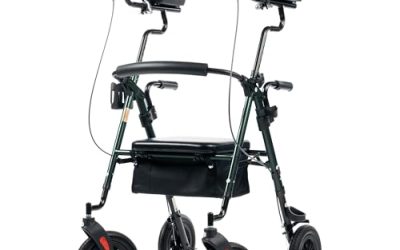
Vive Mobility Upright Walker with Seat
- Best for: Taller users who need the widest handle height range in this guide.
- Handle height adjusts from 45 to 52 in with locking push pins
- Forearm pads adjust forward and backward
- 8 in flat-free wheels
- Seat measures 17.5 in wide
Taller users who need the widest handle height range in this guide.
The 8-inch wheels are best on smooth ground, so test the ride on rough pavement before relying on it outdoors. Check the folded width against your car boot, since the tall frame folds to a long package.
The Vive upright walker suits taller users who have struggled to find a rollator with enough handle height. Its handles adjust from 45 to 52 inches, which covers users from about 5 feet 2 inches to 6 feet 4 inches according to the listing, and the forearm pads slide forward and backward to match different arm lengths. The aluminium frame keeps the weight near 20 pounds, the 8-inch flat-free wheels suit indoor floors and pavements, and the 17.5-inch wide seat gives a place to rest on longer outings. A detachable shoulder bag stores essentials close at hand.
Watch out for: The 8-inch wheels are best on smooth ground, so test the ride on rough pavement before relying on it outdoors. Check the folded width against your car boot, since the tall frame folds to a long package.
ELENKER All-Terrain Upright Rollator Walker
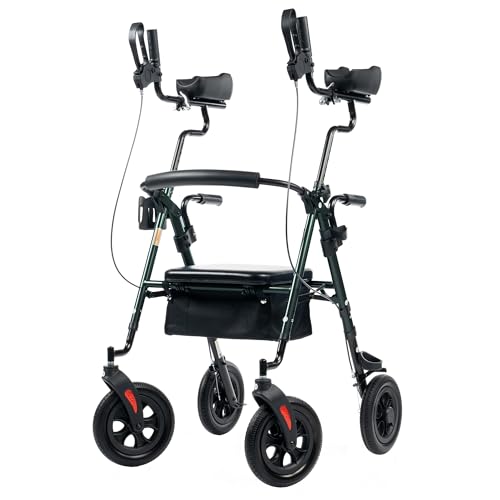
- Best for: Outdoor walking on rough or uneven surfaces where bigger wheels matter.
- Adjustable armrest height from 38.6 to 48.4 in
- 10 in PU wheels, front and rear
- Adjustable seat height from 21.3 to 23.2 in
- Seat measures 18.5 in long by 10.6 in deep
Outdoor walking on rough or uneven surfaces where bigger wheels matter.
At 30 pounds it is the heaviest model in this guide, so loading it into a car takes real effort. Some buyers report the upright armrests need unscrewing to fold the frame flat for transport.
The ELENKER all-terrain model is the pick for outdoor walking on bumpy pavements, park paths, and uneven ground. Its 10-inch PU wheels are puncture-proof and need no inflation, and the padded armrests adjust in height from 38.6 to 48.4 inches as well as in length and holding angle. A foam cushion seat with a PU cover is firmer than a mesh sling seat, which makes sitting down and standing up easier, and the under-seat basket plus cane holder keep your hands free. The reinforced aluminium frame is rated for users from 4 feet 8 inches to 6 feet 4 inches.
Watch out for: At 30 pounds it is the heaviest model in this guide, so loading it into a car takes real effort. Some buyers report the upright armrests need unscrewing to fold the frame flat for transport.
Helavo Upright Walker with Seat
- Best for: Outdoor trips where cushioned rubber tires and a wide seat matter most.
- Handle height adjusts from 40.9 to 46.9 in
- 10 in puncture-proof rubber front tires
- Seat measures 18.9 in wide
- Aluminium frame weighs 22.7 lb
Outdoor trips where cushioned rubber tires and a wide seat matter most.
The handle range tops out at 46.9 inches, so users above about 6 feet should measure their elbow height first. The frame is 26.4 inches wide, so check it against narrow doorways at home.
The Helavo upright walker stands out for its 10-inch solid rubber front tires, which cushion the ride without any risk of a flat. Its handles adjust from 40.9 to 46.9 inches using a slide system rather than push buttons, and the padded backrest adjusts in height as well. The aluminium frame weighs 22.7 pounds and supports up to 300 pounds, while the 18.9-inch wide cushioned seat and included cup and cane holders cover the practical details. It folds for storage and comes with a one-year warranty that can be extended.
Watch out for: The handle range tops out at 46.9 inches, so users above about 6 feet should measure their elbow height first. The frame is 26.4 inches wide, so check it against narrow doorways at home.
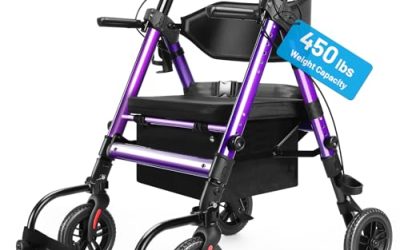
BlessReach Heavy Duty Upright Rollator Walker
- Best for: Users who need the highest weight capacity and a quick-folding frame.
- Supports up to 450 lb
- 6-level adjustable handles
- 8 in all-terrain wheels with 360-degree swivel front wheels
- Padded seat and adjustable backrest
Users who need the highest weight capacity and a quick-folding frame.
The frame is heavy for its size, so ask someone to help with lifting it into a car if that is a concern. Confirm the handle height range on the listing matches your elbow height before ordering, since the listing states six levels without a single published range.
The BlessReach heavy duty model is the one to consider when weight capacity is the deciding factor. Its frame is rated to 450 pounds, the highest in this guide, and the handles offer six levels of height adjustment with padded armrests that rotate and adjust in width. The 8-inch all-terrain wheels include 360-degree swivel front wheels for turning in tight spaces, and the flip-up seat with quick-release levers folds away in seconds. A large-capacity bag and cup holder are included, and the padded seat and backrest adjust for comfort.
Watch out for: The frame is heavy for its size, so ask someone to help with lifting it into a car if that is a concern. Confirm the handle height range on the listing matches your elbow height before ordering, since the listing states six levels without a single published range.
Which One Fits Your Situation
You are taller than average and need the height
Pick the Vive Mobility Upright Walker with Seat. Its handles reach 52 inches, the highest top end in this guide, and the listing covers users up to 6 feet 4 inches. The forearm pads also slide forward and backward, which helps when a tall frame comes with longer arms. Measure your elbow height first, and leave a couple of inches of adjustment above it.
Most of your walking happens outdoors on rough ground
Pick the ELENKER All-Terrain Upright Rollator Walker. The 10-inch PU wheels handle cracks and uneven pavement better than the smaller wheels in this guide, and the armrests adjust in height, length, and angle. Accept the 30-pound weight in exchange for the steadier ride, and plan how you will lift it into the car.
You want cushioned wheels and a wide seat for daily trips
Pick the Helavo Upright Walker with Seat. Its solid rubber front tires cushion bumps without ever going flat, and the 18.9-inch wide seat is the roomiest here. The slide adjustment for handle height is simple to use, and the cup and cane holders keep everyday items within reach on errands.
Weight capacity is your first concern
Pick the BlessReach Heavy Duty Upright Rollator Walker. Its 450-pound rating is well above the 300-pound rating of the other three models, and the six handle levels let you fine-tune the fit. The flip-up seat folds away fast, which helps when the rollator needs to fit into a smaller storage space.
Common Mistakes
- Buying by the photo instead of the handle range: measure your elbow height and check it against the listed range before ordering.
- Ignoring the folded size: an upright rollator that fits your hallway may still be too long or too wide for your car boot.
- Assuming every model adjusts the same way: some adjust only up and down, while others also move the armrests forward, backward, or at an angle.
- Sitting down without locking the brakes: always set the parking brake before using the seat, and test that it holds on your own floor surface.
- Skipping a professional opinion: a doctor or physical therapist can confirm whether an upright rollator suits your balance and walking needs.
Frequently Asked Questions
What handle height should I choose on an upright rollator?
Measure from the floor to your elbow while standing upright in your usual shoes. Choose a model whose stated handle or armrest range includes that number with adjustment room on both sides. If your elbow height sits near the top or bottom of a range, pick a model with a wider range so you can fine-tune the fit.
Are upright rollators better than standard rollators?
They serve different needs. An upright rollator supports your forearms on padded rests so you can walk with your hands higher and your back straighter, while a standard rollator has lower handgrips you hold with your hands. Which one fits depends on your height, arm comfort, and what your doctor or therapist recommends.
Can I use an upright rollator outdoors?
Yes, and wheel choice decides how well it works outside. Larger wheels and rubber or PU tires handle cracks, grass edges, and uneven pavement better than small hard wheels. Check the wheel size and material on the listing, and test the brakes on the surfaces you walk most before relying on the rollator for longer trips.
How do I lock the brakes before sitting on the seat?
Most upright rollators use loop brakes: squeeze them to slow down and push them down or outward to lock them as a parking brake. Lock the brakes every time before you sit, and give the frame a gentle push to confirm it stays still. If the brakes slip on your floor, have them checked before using the seat.