
Key takeaways
- Low-profile and flush-mount ceiling fans for apartment rooms with low ceilings, with clearance math, sizing rules and five picks from 42 to 52 inches.
A ceiling fan is one of the few cooling upgrades that gives floor space back instead of taking it. In a small apartment, a tower fan or pedestal fan claims a corner, a power outlet and a permanent spot in your walking path. A ceiling fan claims nothing at floor level, circulates air across the whole room instead of one seating spot, and doubles as the room’s main light when it has a built-in kit. The catch is that apartments fight back: ceilings are often 8 feet instead of the 9 or 10 feet fan catalogs assume, rooms are small enough that an oversized fan looks and feels wrong, and the electrical box in the ceiling may never have been rated for a spinning fixture. This guide works through that clearance math first, then five fans that fit real apartment rooms, from a 42-inch flush mount for a small bedroom to a 52-inch smart fan for an open-plan living area.
As an Amazon Associate, we earn from qualifying purchases.
Quick Answer
For most apartment rooms, choose a flush-mount fan between 42 and 52 inches and check that the blades will sit at least 7 feet above the floor. The Hunter Newsome is the small-bedroom pick, the Portage Bay West Hill covers living rooms on a budget tier, the Dreo adds app and voice control, and the Minka-Aire Simple is the premium DC-motor option.
The Clearance Math That Decides Everything
Ceiling fans follow a simple safety rule of thumb: the blades should end up at least 7 feet above the floor so nobody walking underneath, stretching, or climbing onto a bed meets them. Work backwards from your ceiling. An 8-foot ceiling is 96 inches. Subtract the 84 inches of clearance and the entire fan, from ceiling mount to the bottom of the motor housing, gets a budget of about 12 inches. That single number eliminates most standard fans, because a typical downrod model hangs 14 to 18 inches before the light kit is even counted.
This is why mount type matters more in an apartment than motor brand. Hugger and low-profile fans bolt almost directly to the ceiling and usually finish 8 to 11 inches deep, which keeps blades legal in an 8-foot room. A short 4-inch downrod can still work in a 9-foot room. Anything longer belongs in homes with taller ceilings. Measure before ordering, at the fan location rather than the wall, because older ceilings are rarely level.
The second check is invisible. A ceiling fan weighs far more than a light fixture and adds vibration, so it must hang from an electrical box rated for fan support, usually marked inside the box. Many apartment ceiling boxes are fan-rated already, especially in newer buildings where a fan was an option. If yours is not, a retrofit brace kit that expands between the joists solves it without opening the ceiling. If neither you nor an electrician can confirm the box, that is a hard stop, and it is covered again in the skip section below.
The Five Picks
Hunter Newsome 51080: The Small-Bedroom Flush Mount
The Newsome is built for exactly the room apartments have most of: a bedroom under 120 square feet with an 8-foot ceiling. Its low-profile housing fits flush against ceilings under 9 feet, and the 42-inch span matches small-room sizing instead of overwhelming it. The integrated LED kit replaces the ceiling light you lose, bulbs are included, and control is a simple pull chain, which matters in a bedroom where a lost remote at 2 a.m. is a real failure mode.
Specs
- Blade span: 42 inches
- Mounting: Low-profile flush mount for ceilings under 9 feet
- Light: Integrated LED light kit, bulbs included
- Control: Pull chain
- Blades: 5
- Finish: Fresh White
- Model: 51080
Portage Bay West Hill 50251: The Budget 52-Inch Hugger
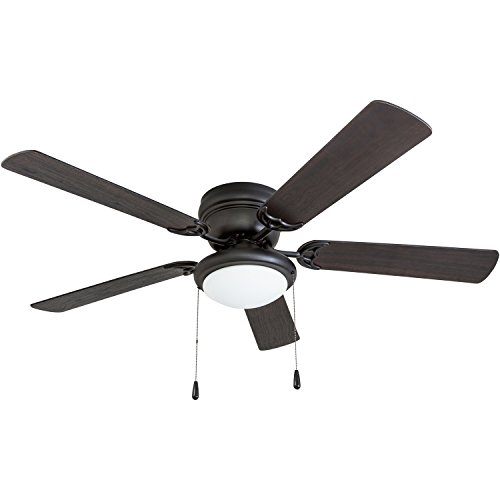
Living rooms need a bigger sweep, and the West Hill delivers 52 inches in a true hugger mount that stays tight to the ceiling. That combination, full-size span with flush mounting, is what makes it useful in an apartment living room where a downrod fan would hang too low. The bowl light kit keeps the single-fixture lighting setup most apartments have, and the reversible motor lets you push warm air down in winter. It sits firmly in the budget tier of this list while covering the largest rooms here.
Specs
- Blade span: 52 inches
- Mounting: Hugger flush mount
- Light: Bowl light kit included
- Control: Pull chain, reversible motor
- Blades: 5
- Finish: Matte Black
- Model: 50251
Honeywell Carmel 50197-01: Mid-Size With a Real Remote

The Carmel is the pick for a primary bedroom or dining space with a 9-foot ceiling, where its included 4-inch downrod is an asset instead of a problem. At 48 inches it splits the difference between the bedroom and living-room sizes. The remote, which docks on the wall so it behaves like a light switch, adjusts speed and light from the bed or sofa. Blades are dual-finish, Cimmeron on one side and Ironwood on the other, so the look can change without new parts. Published airflow is 5,202 CFM on high, strong for this size class.
Specs
- Blade span: 48 inches
- Mounting: Downrod mount, 4-inch downrod included
- Light: Integrated LED, 1,600 lumens, 3000K
- Control: Remote control with wall dock
- Airflow: 5,202 CFM on high, 3 speeds
- Blades: 5, dual-finish Cimmeron and Ironwood
- Finish: Bronze
- Model: 50197-01
Dreo Smart Ceiling Fan DR-HCF002S: The App-Controlled Option
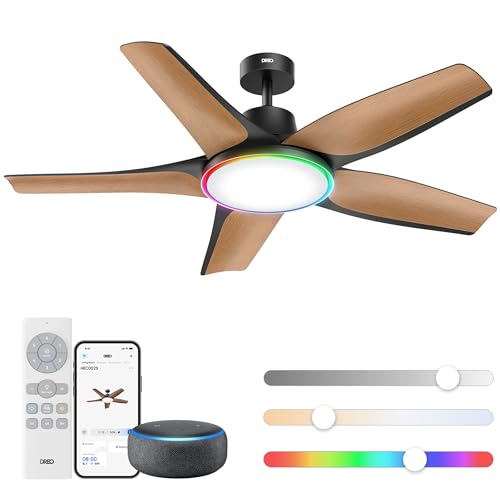
The Dreo takes the low-profile format and adds the control layer the other picks lack. It is a 52-inch fan with a DC motor, run from the included remote, the Dreo app, or Alexa voice commands, so schedules, timers and speed changes happen from the sofa. The light is dimmable with stepless color tuning, and an RGB ambient ring handles low-level evening light without the main lamp. For a studio apartment where one fixture does every job, that flexibility is the point. It is the mid-range to premium step here, priced by its electronics rather than its size.
Specs
- Blade span: 52 inches
- Mounting: Low-profile mount
- Motor: DC motor
- Light: Dimmable LED with color tuning, RGB ambient light
- Control: Remote, Dreo app, Alexa voice control
- Finish: Black
- Model: DR-HCF002S
Minka-Aire Simple F787-WHF: The Premium DC Pick

The Simple is the fan for a living room you plan to stay in. Its DC motor drives three wide ABS blades at six speeds and up to 6,231 CFM, and DC operation keeps it quiet at the low speeds you sleep and read under. Total height is about 12.6 inches on the included 6-inch downrod, so it suits 9-foot ceilings. There is no light in the box; an LED kit is available separately, and a Bond bridge can be added later for app and voice control. It is wet rated and Energy Star certified, the premium tier of this roundup.
Specs
- Blade span: 52 inches
- Mounting: Downrod mount, 6-inch downrod included, about 12.6 inches total height
- Motor: DC motor, 6 speeds
- Airflow: Up to 6,231 CFM
- Control: RC400 remote included, Bond bridge compatible
- Light: None included, optional light kit sold separately
- Blades: 3, ABS
- Rating: Wet rated, Energy Star certified
- Finish: Flat White
- Model: F787-WHF
How to Choose
Start with the ceiling, not the catalog. Measure the ceiling height, subtract 84 inches, and the result is the deepest fan you can hang. Under about 11 inches of budget, only hugger and low-profile models qualify. Next, size the span to the room: 42 inches suits rooms up to roughly 120 square feet, 48 inches covers medium bedrooms and dining rooms, and 52 inches is right for living rooms and open-plan spaces up to about 400 square feet. An oversized fan in a tiny room does not cool better; it just adds downdraft you cannot escape.
Then decide on the motor. AC motors are simpler and cheaper, usually with three speeds and a pull chain. DC motors cost more but run quieter, offer five or six speeds, reverse from the remote instead of a switch on the housing, and use less electricity at low speed. In a bedroom, that quiet low speed is worth more than peak airflow. Finally, settle the light question. Most apartments have one ceiling fixture per room, so a fan without a light leaves the room dark unless lamps take over. If the fan replaces the room’s only light, choose an integrated LED kit and check its output in lumens; 1,600 lumens is a sensible floor for a main light.
Before ordering, confirm two practical things: the ceiling box is fan-rated or a brace kit is in the plan, and your lease position on swapping a hardwired fixture, which the next section covers.
Who Should Skip a Ceiling Fan
Skip the project, for now, if your lease forbids changing hardwired fixtures and your landlord will not approve it in writing. A ceiling fan is not a plug-in appliance; it replaces a wired fixture, and in many rentals that decision is not the tenant’s to make. A plug-in tower or desk fan is the fallback that keeps the deposit safe.
Also skip it if the math fails: ceilings under 8 feet with tall occupants, or a loft bed or bunk bed that puts a sleeper’s head near blade height, leave no safe clearance for any fan. And skip it if the ceiling box cannot be verified as fan-rated and cannot be braced, because no airflow is worth a fixture working loose. In all three cases the room is better served by the plug-in options until the building allows the upgrade.
Frequently Asked Questions
How much clearance does a ceiling fan need in an apartment?
Plan for the blades to sit at least 7 feet above the floor. With an 8-foot ceiling that leaves roughly 12 inches for the whole fan, which is why flush-mount and hugger models dominate this list. Taller occupants and loft furniture eat into that margin, so measure with the room’s actual use in mind.
What size ceiling fan fits a small bedroom?
A 42-inch fan is the standard fit for bedrooms up to about 120 square feet, which covers most apartment bedrooms. A 48-inch model works in a larger primary bedroom. Going straight to 52 inches in a small room adds noise and downdraft without better cooling.
Can renters install a ceiling fan?
Only with the landlord’s permission, because the fan replaces a hardwired light fixture and needs a fan-rated electrical box. Get approval in writing, keep the original fixture to reinstall at move-out, and use a licensed electrician if the box needs a brace. Without permission, a plug-in fan is the safe route.
Do ceiling fans help in winter as well?
Yes, if the motor reverses. Running the fan slowly in reverse pushes the warm air pooled at the ceiling down the walls without a direct breeze, which evens out room temperature. Every pick in this list with a reversible motor can do it; on DC models the remote handles the change.
Final Verdict
Apartments reward the fan that fits the ceiling, not the fan with the biggest numbers. For a small bedroom, the Hunter Newsome is the straightforward answer: flush, lit, and simple. The Portage Bay West Hill stretches that same flush-mount idea to living-room size on a budget tier. The Honeywell Carmel suits 9-foot ceilings and anyone who wants a wall-docked remote, the Dreo is the connected option for studios, and the Minka-Aire Simple is the premium DC fan for a living room that will host it for years. Measure the ceiling, check the box, then choose by room size.


