Our Short List of 3
- View on Amazon: https://www.amazon.com/dp/B07X7FF5B1
- View on Amazon: https://www.amazon.com/dp/B07X7FVJMH

- View on Amazon: https://www.amazon.com/dp/B07C8LM3CL
All 3 Picks at a Glance
| Product | Specs | Action |
|---|---|---|
| 1. LandShark LS2000 External Pond Pump, 2000 GPH |
| Check price on Amazon |
| 2. LandShark LS3000 External Pond Pump, 3300 GPH |
| Check price on Amazon |
| 3. LandShark LS5500 External Pond Pump, 5575 GPH |
| Check price on Amazon |
Key takeaways
- Best external pond pumps with prefilters compared: three self-priming pumps with debris baskets, rated by flow, head height, power and upkeep.
The best external pond pumps with prefilters sit beside the pond rather than inside it, and each one carries a built-in strainer basket that catches leaves and twigs before they can reach the impeller. That combination matters because an external pump is only as reliable as its intake: a basket that is easy to see and easy to empty keeps the pump moving water instead of straining against a clog. The three pumps below all share the same basic design — a self-priming, direct-drive external pump with a removable oversized debris basket under a clear quick-release cover — and they differ mainly in flow, lift, and power draw. All three come from the same manufacturer line, which makes the comparison unusually clean: the basket, the motor style, and the warranty are the same, so the choice comes down to matching flow and head height to the pond.
An external pump earns its place by staying dry. It sits in a pump house, a pit, or a sheltered spot beside the pond, connected by plumbing rather than dropped into the water. That placement makes routine service simpler, since the basket can be checked without wading in or lifting a wet pump out of the pond. The trade-off is that an external pump needs a dry location, protection from rain, and plumbing that is planned in advance. Self-priming models handle much of the start-up work themselves, which is why all three pumps in this roundup are self-priming.
What to Look For in an External Pond Pump With a Prefilter
Start with the prefilter itself, because it is the feature that defines this category. A good prefilter basket is oversized relative to the pump, so it holds a useful amount of debris before flow drops, and it is removable without tools. A clear cover is worth having, because it lets the pond owner see when the basket needs emptying instead of guessing or waiting for flow to fall. The basket should sit ahead of the impeller, trapping twigs, leaves, and other coarse debris while letting water pass freely. All three pumps below use this arrangement, with a clear quick-release cover over the basket.
Flow rate, measured in gallons per hour, is the next figure to match to the pond. A common planning rule is to circulate the full pond volume about once per hour, so a pond holding around 2,000 gallons pairs naturally with a pump rated near 2,000 GPH, while a larger pond or a tall waterfall needs a higher rating. The rated flow is a maximum measured with little or no lift, so real-world flow falls as the pump pushes water uphill or through long pipe runs and elbows. Choosing a pump with some headroom above the minimum keeps circulation steady when the basket starts to collect debris.
Maximum head height describes how high the pump can lift water. A waterfall that rises several feet above the pump needs a pump whose maximum head comfortably exceeds that rise, because flow drops sharply as the lift approaches the maximum. The pumps below range from 20 feet to 40 feet of maximum head, which covers low garden waterfalls through to taller features.
Power draw matters because a pond pump runs continuously. The smallest pump here draws 250 watts, the mid-size pump draws 400 watts, and the largest draws 1,100 watts. All three run on a standard 120-volt supply, and the manufacturer advises a dedicated 15-amp GFI circuit rather than an extension cord. The short 4.5-foot cord on each model means the outlet needs to sit close to the pump location, so plan the electrical run before choosing a spot for the pump. Each pump also carries a two-year manufacturer warranty, a hydraulically self-balancing impeller, a sealed self-lubricating direct-drive motor, and a thermal sensor that guards against overheating if flow is blocked.
The Best External Pond Pumps With Prefilters
1. LandShark LS2000 External Pond Pump, 2000 GPH
- View on Amazon: https://www.amazon.com/dp/B07X7FF5B1
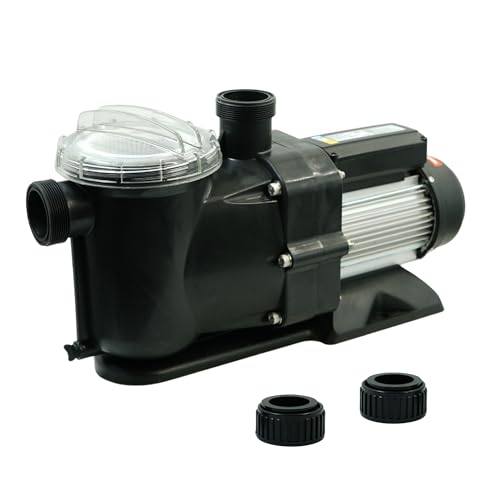
The LandShark LS2000 is the smallest pump in this roundup, rated at 2,000 GPH with a 1/3 HP self-priming direct-drive motor. It is the natural fit for a modest pond or a low waterfall where a larger pump would move more water than the feature needs. Its maximum head height is 20 feet, which suits gentle lifts and short pipe runs, and it draws 250 watts at 3.0 amps on a 120-volt supply — the lowest power draw of the three pumps here, which keeps running costs down over a season of continuous operation.
The prefilter is the same oversized debris basket used across the LandShark line, with a clear quick-release cover. The basket traps twigs and leaves before they reach the impeller, and the clear cover makes it possible to check the basket at a glance. Because the basket is removable, emptying it is a matter of lifting it out, clearing it, and dropping it back in, with no tools involved. For a pond under trees, where leaves arrive daily in autumn, that quick access is the difference between a five-minute chore and a neglected pump.
The LS2000 measures 20.5 by 7 by 12 inches and weighs 10 pounds according to the manufacturer specification table, so it fits into a compact pump housing or a small pit beside the pond. Its outlet is a G2 by 2-inch slip fitting, and the 4.5-foot power cord means the GFI receptacle should sit within a few feet of the installation point.
Who it suits: Pond owners with a pond of around 2,000 gallons or a low waterfall who want the lowest power draw and the most compact external pump in this line.
Considerations: The 20-foot maximum head and 2,000 GPH rating set a clear ceiling, so it is not the pump for a tall waterfall or a long pipe run. The short cord means the electrical supply needs to be planned close to the pump, and the pump needs a dry, sheltered location out of the weather.
2. LandShark LS3000 External Pond Pump, 3300 GPH
- View on Amazon: https://www.amazon.com/dp/B07X7FVJMH
The LandShark LS3000 sits in the middle of this roundup, rated at 3,300 GPH with a 1/2 HP self-priming direct-drive motor. One naming detail is worth knowing before ordering: the Amazon listing title reads LS3000, while the manufacturer part number printed in the specification table is LS3300. They are the same pump, and the listing specifications match the manufacturer table for the LS3300 exactly.
With a maximum head height of 24 feet, this pump handles taller waterfalls and longer pipe runs than the LS2000, while drawing 400 watts at 5.0 amps on a 120-volt supply. That combination makes it a good middle ground for a mid-size koi pond or a waterfall with a moderate rise, where the smallest pump would be working near its limit and the largest pump would be more than the system needs. The extra flow also gives the pond more turnover, which helps keep water moving through a filter or over a waterfall feature.
The prefilter follows the same design as the rest of the line: a built-in, removable, oversized debris basket with a clear quick-release cover. The basket catches twigs and leaves ahead of the impeller, and the clear cover allows a quick visual check. The pump body measures 20.5 by 7 by 12 inches, the same footprint as the LS2000, and weighs 12 pounds per the manufacturer table. Its outlet is a G2 by 2-inch slip fitting, and the cord is 4.5 feet long.
Who it suits: Owners of mid-size ponds or waterfalls with a moderate lift who want a clear step up in flow and head from the LS2000 without moving to the largest pump in the line.
Considerations: The 400-watt draw is higher than the LS2000, so running costs rise with the extra flow. The 4.5-foot cord again puts the outlet close to the pump, and the pump needs the same dry, sheltered installation as the rest of the line. Buyers should confirm they are ordering the LS3000 listing, since the manufacturer part number reads LS3300.
3. LandShark LS5500 External Pond Pump, 5575 GPH
- View on Amazon: https://www.amazon.com/dp/B07C8LM3CL
The LandShark LS5500 is the largest pump in this roundup, rated at 5,575 GPH with a 1.5 HP self-priming direct-drive motor. Its maximum head height of 40 feet is nearly double that of the LS2000, which makes it the pump for large ponds, tall waterfalls, and long plumbing runs where the smaller models would lose too much flow. The pump draws 1,100 watts at 9.2 amps on a 120-volt supply, so it needs a dedicated circuit and a realistic look at running costs, but that draw is what buys the high flow and the 40-foot lift.
The prefilter is the same built-in, removable, oversized debris basket with a clear quick-release cover used by the smaller models. At this flow rate the basket earns its keep, because a pump moving more than 5,000 gallons per hour pulls in debris quickly, and a basket that can be seen through its clear cover and emptied without tools keeps that flow from dropping off. The basket traps twigs and leaves before they reach the impeller, and the thermal sensor, self-balancing impeller, and sealed self-lubricating motor carry over unchanged from the smaller pumps.
The LS5500 measures 21 by 7.5 by 10 inches and weighs 16 pounds according to the manufacturer specification table. Its outlet offers both a 1.5-inch MIPT fitting and a G2 by 2-inch slip fitting, which gives more plumbing options than the two smaller models. The cord is 4.5 feet long, and the pump carries the same two-year manufacturer warranty. The manufacturer suggests this size of pump for a pond of around 3,000 gallons paired with a 2-inch waterfall, which gives a sense of the scale it is built for.
Who it suits: Owners of large ponds, tall waterfalls, or long pipe runs who need high flow and high lift from a single external pump with a prefilter basket.
Considerations: The 1,100-watt draw is the highest here by a wide margin, so running costs deserve a careful look before choosing this model. The pump is also the heaviest of the three, and it still needs a dry, sheltered spot with a nearby GFI outlet. A pump this large is more than a small pond needs, and oversizing wastes electricity without improving the pond.
Comparison Table
| Pump | Max flow | Max head | Motor | Power | Cord | Outlet | Weight | Warranty |
|---|---|---|---|---|---|---|---|---|
| LandShark LS2000 | 2,000 GPH | 20 ft | 1/3 HP | 250 W, 3.0 A | 4.5 ft | G2 x 2 in slip | 10 lb | 2 years |
| LandShark LS3000 (LS3300) | 3,300 GPH | 24 ft | 1/2 HP | 400 W, 5.0 A | 4.5 ft | G2 x 2 in slip | 12 lb | 2 years |
| LandShark LS5500 | 5,575 GPH | 40 ft | 1.5 HP | 1,100 W, 9.2 A | 4.5 ft | 1.5 in MIPT, G2 x 2 in slip | 16 lb | 2 years |
All three pumps are self-priming external pumps with a built-in removable oversized debris basket, a clear quick-release cover, a thermal sensor, a self-balancing impeller, and a sealed self-lubricating direct-drive motor, running on 120 volts.
Choosing for Your Use Case
Match the pump to the pond volume first. A pond of around 2,000 gallons pairs with the LS2000, a mid-size pond or a waterfall with a moderate rise pairs with the LS3000, and a large pond or a tall feature pairs with the LS5500. Sizing by volume alone is only a starting point, because head height changes everything: a waterfall that rises ten feet above the pump needs a pump whose maximum head leaves comfortable margin above that rise, since flow falls as lift increases. Pipe length, elbows, and fittings add friction that also cuts flow, so a system with a long run or several bends benefits from the next pump up.
Think about where the pump will live before ordering. An external pump needs a dry spot beside the pond, shelter from rain, and a GFI outlet within reach of a 4.5-foot cord. A pump house or a covered pit works well, and the spot should leave room to open the clear basket cover and lift the basket out for cleaning. Placing the pump below the pond water level helps with priming, and self-priming operation handles the rest on start-up.
Power draw is the ongoing cost, so weigh it against the flow gained. The LS2000 at 250 watts costs the least to run, the LS3000 at 400 watts costs more, and the LS5500 at 1,100 watts costs the most by a wide margin. A pump that is larger than the pond needs wastes electricity every hour it runs, while a pump that is too small leaves the pond under-circulated and the waterfall thin. The right size is the smallest pump that still delivers the flow the pond and waterfall need at the actual lift height.
Care and Use
Check the debris basket often, especially in autumn when leaves fall and after storms. The clear quick-release cover makes this a visual check: if the basket looks full, lift it out, clear it, and put it back. A full basket restricts flow, forces the motor to work harder, and can trigger the thermal sensor. Keeping the basket clear is the single most effective maintenance habit for any of these pumps.
Keep the pump dry and ventilated. An external pump should never sit in standing water, and its housing should keep rain off while allowing air to move around the motor. The pump should run on a dedicated 15-amp GFI circuit, and it should not be run on an extension cord. Prime the pump before first use following the manufacturer instructions, and check the plumbing joints for leaks once the system is running. A small leak on the intake side can let air in, which reduces flow and makes priming harder. In a cold climate, drain the pump at the end of the season and store it where it will not freeze with water inside, and check the basket and seals before starting it again in spring.
FAQ
What is a prefilter on an external pond pump?
A prefilter is a strainer basket fitted ahead of the pump impeller that catches leaves, twigs, and other coarse debris before they can enter the pump. On the pumps in this roundup, the prefilter is a built-in, removable, oversized debris basket with a clear quick-release cover, so the basket can be inspected and emptied without tools.
Can an external pond pump sit above the water level?
An external pump can sit above the water level if it is self-priming, and all three pumps here are self-priming. Placing the pump below the pond water level still helps with priming, and the pump always needs a dry, sheltered location out of the weather.
How often should the prefilter basket be emptied?
That depends on how much debris the pond collects. Under trees in autumn, the basket may need checking daily, while a pond with little overhanging foliage may go a week or more between cleanings. The clear cover lets the basket be checked at a glance, and the basket should be emptied whenever it looks full rather than on a fixed schedule.
What size external pond pump does a 2,000-gallon pond need?
A common planning figure is to circulate the full pond volume about once per hour, which points to a pump rated near 2,000 GPH for a 2,000-gallon pond. Head height and plumbing friction reduce real-world flow, so a pond with a tall waterfall or a long pipe run needs a pump rated above the pond volume.
Do external pond pumps need a GFI outlet?
Yes. The manufacturer advises running these pumps on a dedicated 15-amp GFI circuit, and the pumps should not be run on an extension cord. The 4.5-foot cord on each model means the GFI outlet should sit close to the pump location.
Conclusion
The best external pond pumps with prefilters combine a dry-side installation with a basket that is easy to see and easy to empty, and the three LandShark models here cover the range from a modest 2,000-gallon pond to a large feature needing 5,575 GPH and 40 feet of lift. The LS2000 suits smaller ponds and low waterfalls with the lowest power draw, the LS3000 covers mid-size ponds and moderate lifts, and the LS5500 handles large ponds and tall waterfalls. Match flow and head height to the pond, keep the basket clear, and give the pump a dry spot with a nearby GFI outlet.
Disclosure: As an Amazon Associate, we earn from qualifying purchases.