Key takeaways
- Emissions-intact mods for the Ram 6.7L Cummins that stay EPA and CARB legal: S&B cold air intake with a CARB EO number, Edge Insight CTS3 monitor, Mishimoto intercooler with CARB EO, and emissions-intact inline tuning explained.
As an Amazon Associate we earn from qualifying purchases.
Disclosure: This article contains affiliate links. If you buy through a link on this page, we may earn a commission at no extra cost to you.
The 6.7L Cummins in the Ram 2500 and 3500 does not need much help to tow, but it responds well to the right supporting modifications: freer intake airflow, cooler and denser charge air, better information on the dash, and, chosen carefully, calibration support that works with the emissions system instead of against it. This guide is deliberately limited to that legal side of the fence. Every modification below keeps the diesel particulate filter, the exhaust gas recirculation system, the selective catalytic reduction system and its diesel exhaust fluid dosing fitted and functioning, and the picks are parts with a documented compliance story, including California Air Resources Board Executive Order numbers where the maker publishes them.
That boundary is not a stylistic choice. Removing or defeating emissions equipment on a road-driven truck — the cluster of modifications usually sold under the word delete — is illegal for on-road use under the United States Clean Air Act, exposes owners and shops to substantial federal penalties, voids powertrain warranty coverage, and makes the truck unsaleable through normal channels in many states. This guide does not recommend delete kits, delete tuners or delete pipes, does not explain how to perform a delete, and does not treat off-road-only parts as a loophole for a truck that is driven on public roads. If a product’s power claims depend on removing emissions hardware, it has been excluded here, however popular it is in forum threads.
The Legal Framework in Plain Terms
Two layers of law govern what you can bolt onto a 6.7L Cummins. Federally, the Environmental Protection Agency prohibits tampering with emissions controls and prohibits defeat devices, and that prohibition covers the owner who installs the parts as well as the businesses that sell and fit them. In California, and in the states that follow California’s rules, an aftermarket part that affects emissions generally needs a CARB Executive Order — an EO number — to be legal for sale and use on a pollution-controlled vehicle on public roads. An EO number is specific: it names the part, the maker and the vehicle applications it covers, so an EO for one model year range does not automatically bless the same part on another range.
Practical buying rules follow from that. First, look for the EO number for any part that touches intake air, fuelling, calibration or exhaust flow, and check that your exact model year is inside its coverage. Second, treat phrases like race use only, off-road only and competition use as what they are: statements that the part is not legal on a road truck, not marketing decoration. Third, keep the paperwork — the EO documentation and the emissions label that compliant parts ship with belong in the glovebox, where an inspector can be shown them. The four modifications below were chosen because they can each be defended on that paperwork test.
Quick Comparison
| Pick | Mod type | Emissions position | Best for |
|---|---|---|---|
| S&B Filters 75-5068 Cold Air Intake | Sealed cold air intake | CARB EO published for the application; street legal in all states per retailer listings | 2013–2018 trucks wanting airflow with filtration data |
| Edge Insight CTS3 (84130-3) | OBD-II monitor and gauge display | Monitor only; writes no calibration and alters no emissions control | Any OBD-II Ram wanting EGT, regen and boost visibility |
| Mishimoto MMINT-RAM-13 Intercooler | Bar-and-plate intercooler | CARB EO D-759-22 published for the application | 2013–2018 trucks towing in heat or at altitude |
| Banks Derringer Inline Tuner | Inline power module | Emissions-intact design; verify the EO coverage for your exact year before buying | Owners wanting extra towing power without a flash or hardware removal |
1. S&B Filters 75-5068 Cold Air Intake — Airflow With Test Data and an EO Number
ASIN: N/A — no reliable Amazon US ASIN for this exact kit could be confirmed from an indexed Amazon US listing during research, so no code is printed rather than risk a wrong one. The kit, its part number and its compliance data are confirmed from S&B documentation and diesel retailer listings described below.
The intake is the safest first modification on a modern diesel because it changes how freely the engine breathes without touching fuelling or emissions hardware, and the S&B 75-5068 is the benchmark kit for the 2013–2018 Ram 2500 and 3500 with the 6.7L Cummins. S&B publishes proper test data rather than adjectives: in ISO 5011 testing, the cotton cleanable version is rated as flowing 54.60 percent better than the stock airbox at 99.55 percent filtration efficiency, and the dry extendable version, the 75-5068D, flows 51.70 percent better at 99.49 percent efficiency. Retailer listings for the kit publish a CARB Exempt ID — cited as D-590-33 in current diesel retailer data — and describe the kit as street legal in all fifty states; confirm the EO number printed on the documentation in your box matches your model year, because EO coverage is application-specific.
The kit replaces the factory airbox with a sealed box, a large filter — replacement element KF-1037 for the oiled cotton version, which ships with a measured quantity of red filter oil — silicone couplers and an intake tube, and it keeps a clear lid so the filter’s condition is visible at a glance. Choosing between the two filter media is a use decision: the oiled cotton element is washable and reusable and suits most road trucks, while the dry extendable element needs no oil and suits trucks that live in dust, where an over-oiled filter is a real-world mistake. Neither version requires any change to the truck’s emissions equipment or calibration, which is precisely why this modification sits at the top of a legal list.
Expect throttle response and turbo sound to change more than peak output on an otherwise stock truck; the honest value of the intake is reduced restriction, published filtration efficiency at least equal to what a diesel needs, and headroom that the later modifications in this guide can use. Fitment discipline matters: this kit is for 2013–2018 trucks, and other Cummins generations use different S&B part numbers, so order by exact year rather than by engine name alone.
2. Edge Insight CTS3 (84130-3) — The Monitor That Keeps a Legal Truck Honest
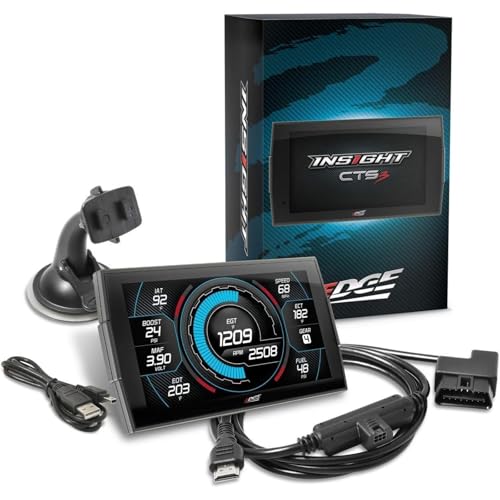
A monitor is the one modification on this list with zero emissions ambiguity, because the Edge Insight CTS3 does not tune anything. It is a monitor-only digital gauge display — Edge part number 84130-3 — that plugs into the OBD-II port of 1996-and-newer vehicles and displays the data the truck already broadcasts: exhaust gas temperature where a sensor is available, boost, coolant and transmission temperatures, diesel particulate filter status and regeneration state, gear and torque converter behaviour, and dozens of other parameters, on a five-inch colour touch screen with configurable gauge layouts. It also reads and clears diagnostic trouble codes, which on an emissions-equipped truck is a genuinely useful ownership tool rather than a performance claim.
That visibility changes how a 6.7L Cummins gets driven and maintained. Watching regeneration status stops the classic mistake of switching off mid-regen and leaving the filter loaded. Watching exhaust gas temperature while towing a grade tells you when to back out or drop a gear long before the truck has to protect itself. And a code read at home, before a workshop visit, separates a loose sensor from a failing component — particularly valuable on a truck whose aftertreatment system is expensive precisely because it is sophisticated.
The CTS3’s Amazon listing data confirms the part number 84130-3 and Edge Products as the manufacturer behind the listing. Because it writes no calibration and intercepts no signals, it raises no CARB EO question of its own and pairs safely with every other pick in this guide, including a stock truck with no other modifications. If you buy only one item from this page, this is the lowest-risk one: it makes the driver better informed without making the truck any less legal.
3. Mishimoto MMINT-RAM-13 Intercooler — Cooler Charge Air, CARB EO Included
ASIN: N/A — no reliable Amazon US ASIN for this intercooler could be confirmed from an indexed Amazon US listing during research, so no code is printed rather than risk a wrong one. The part, its specification and its CARB EO number are confirmed from Mishimoto data carried by multiple diesel retailers, as described below.
Charge-air cooling is the most mechanically honest power support there is: it makes no fueling demands, defeats nothing, and simply gives the turbo’s compressed air a better heat exchanger. Mishimoto’s intercooler for the 2013–2018 Ram 6.7L Cummins, the MMINT-RAM-13, is built around a bar-and-plate core with cast aluminium end tanks, replacing a stock unit that was notably downsized when Ram relocated it on the 2013 redesign. Mishimoto’s published figures for the intercooler kit describe a core 37.8 percent larger than stock with 76.65 percent more external fin surface area, and a measured 12.5 percent reduction in intake air temperatures; the core measures 25.7 inches long by 12.5 inches high with three-inch inlet and outlet, and the intercooler ships with silicone boots using DuraCore technology and constant-tension T-bolt clamps under Mishimoto’s lifetime warranty.
The compliance point is documented rather than implied: retailer technical data for this intercooler publishes CARB EO number D-759-22 for the 2013–2018 6.7L Cummins application. That matters because an intercooler is exactly the kind of part owners assume needs no paperwork; on a California-rules truck, having the EO number on record is the difference between an argument and a document.
The benefit shows up where a working truck suffers: long grades, hot weather, altitude and sustained towing, where a heat-soaked stock intercooler lets intake temperatures climb and the engine management trims output to protect itself. A larger, denser core resists that soak. Installation is a front-of-truck job with the bumper and shrouding involved — the kit includes air diversion panels and a replacement lower fan shroud — so allow a proper workshop session rather than a driveway hour. Choose silver or black core finish on specification, not on any performance difference, because there is none.
4. Banks Derringer Inline Tuner — Extra Power That Leaves the Hardware Alone
ASIN: N/A — no reliable Amazon US ASIN for the Ram 6.7L Cummins Derringer application could be confirmed from an indexed Amazon US listing during research, so no code is printed rather than risk a wrong one. The product type, its emissions-intact design and its Cummins application are confirmed from Banks coverage and comparison sources described below.
Calibration is where legality gets decided, so this pick is included with explicit conditions. The Banks Derringer is an inline module: it connects between sensors and the engine control unit and adjusts signals in real time, rather than reflashing the control unit with a new calibration, and Banks designs and markets its diesel tuning line around keeping the emissions system intact and operational — DPF, EGR and SCR all stay fitted and working. Banks supports Ram 6.7L Cummins applications in its Derringer and iDash line, and the module offers switchable power levels with the company’s ActiveSafety monitoring, which reduces output if exhaust temperature or other limits approach unsafe values, and pairs with the iDash gauge display for monitoring.
Those design facts do not remove the buyer’s homework, and this guide will not pretend otherwise. EO coverage for tuning products is specific to maker, device and model-year range — published CARB order data for Ram 6.7L Cummins tuning, for example, covers particular devices for the 2013–2018 range — so before buying any tuner or module, including this one, verify in writing that an EO or equivalent compliance documentation covers your exact truck and year, and walk away from any seller who answers that question with a wink about off-road use. Never combine an inline module with fuelling or airflow parts that lack their own compliance story, and never use any device, from any maker, to disable emissions controls, suppress aftertreatment fault codes or alter regeneration behaviour: a device used that way is a defeat device regardless of how it was marketed.
Driven within those rules, an emissions-intact module is the legitimate way to add towing headroom to a stock-emissions truck: the aftertreatment keeps doing the job it was certified to do, the truck stays saleable and inspectable, and the power arrives with a safety system watching the temperatures that matter. That is the standard every tuning product for this engine should be held to, and it is why products that cannot meet it are absent from this guide.
What We Deliberately Left Out
The exclusions are the point of this article, so they are stated openly. No DPF, EGR or DEF delete kits or pipes. No delete-capable tuners or custom tuning files written for deleted trucks. No emissions defeat devices of any kind, including sensor simulators and code suppressors. No exhaust system that removes the particulate filter or the catalytic components — a compliant exhaust modification on this platform means a filter-back system that leaves every aftertreatment component in place. And no part whose only compliance claim is that nobody checks. Each of those categories is either illegal for on-road use, a warranty and resale liability, or both, and a guide that mixed them in with legal parts would be steering its readers into fines and failed inspections.
Buying Checklist for Legal 6.7 Cummins Mods
Start with your model year and write it on every order, because Cummins fitments and EO coverage change across the 2007.5–2012, 2013–2018 and 2019-and-later generations. For any part touching air, fuel, calibration or exhaust, find the CARB EO number and confirm your year is inside it before paying. Keep every emissions component fitted and functioning, and keep the compliance paperwork with the truck. Add the monitor early: knowing your exhaust temperatures and regeneration status protects every other modification. Buy from sellers who publish compliance documentation rather than from listings that advertise deletes. And if a claimed gain sounds far larger than what the legal parts here deliver, ask what hardware has to come off to achieve it — the answer tells you which side of the law the product lives on.
Follow that checklist and a 6.7L Cummins can be made measurably better to tow with, cooler under load and far better instrumented, while remaining the truck its emissions certification says it is. That is not a compromise version of modifying this engine. It is the version you can drive anywhere, sell to anyone and defend to any inspector — which, for a truck built to work, is the only version worth paying for.