Key takeaways
- Compare two bariatric rollators with adjustable handles, 450-500 lb capacity, padded seats and wide frames, and choose the right support for daily walking.
Buying a bariatric rollator is not the same decision as buying a standard walker with wheels. The frame has to carry far more weight without flexing, the space between the handles has to fit a wider body comfortably, and the seat has to stay supportive when you stop to rest halfway through a trip. Get the capacity or the width wrong and the rollator feels unstable from the first outing, no matter how solid it looked in the product photos.
This shortlist is aimed at heavier adults who walk daily and need real support, at taller users whose handles on a standard rollator never rise high enough, and at families buying for a parent who also needs occasional pushed transport. Both picks were chosen from their Amazon product pages: each is a heavy-duty rollator rated at 450 lb or more, and each states an adjustable handle-height range on its listing rather than a fixed grip height.
Quick Picks
As an Amazon Associate we earn from qualifying purchases.
| Product | Best for | Key spec from title |
|---|---|---|
| Medline Large Steel Bariatric Rollator MDS86800XWS | Maximum rated capacity on a steel frame | 500 lb weight capacity |
| AKOASM Heavy Duty 2-in-1 Rollator Transport Chair Combo | Users who also need a transport chair | 450 lb capacity, converts to transport chair |
How to Choose
Rated capacity versus your real weight
Start with the number printed on the listing, then leave yourself headroom. A rollator rated at 450 lb or 500 lb is built with a reinforced frame, wider tubing and stronger joints than a standard 300 lb model, and that margin matters every time you lean on the handles while standing up from the seat. If your weight sits close to a model’s limit, step up to the higher-rated frame instead of treating the maximum as a target. Capacity also interacts with how you use the seat: resting your full weight on it mid-walk loads the frame differently from a brief perch, so the stronger rating is the safer everyday choice.
Handle height range and your wrist line
Adjustable handles only help if the stated range covers your correct grip height. Stand in your usual walking shoes, let your arms hang, and note where your wrist crease falls; the grips should meet roughly that point so your elbows keep a slight bend while you walk. The Medline adjusts from 31.5 to 37.5 inches, which suits many average-height users, while the AKOASM climbs from 33.9 to 41.3 inches across six levels, a range that finally fits taller frames. If your wrist line falls outside a rollator’s range, no amount of build quality will fix the stooped or shrugging posture that follows.
Frame width, seat size and indoor fit
Bariatric frames are deliberately wider, and that width is what makes them feel planted rather than tippy. The Medline gives 23.5 inches between the handles, so your hips and hands clear the frame as you step through it. Check that same generosity against your home, though: measure your narrowest doorway and bathroom entrance before ordering, because a wide rollator that cannot reach the toilet is a rollator that stops being used. Seat dimensions matter just as much. Look at seat height, depth and padding together, since a seat that sits too low makes standing up again the hardest part of the rest stop.
Wheels, brakes and transport-chair conversion
Eight-inch wheels roll over door thresholds, cracked pavements and carpet edges with less jolting than smaller casters, which matters when more weight presses down through the frame. Brake design deserves equal attention: the AKOASM’s three-mode brakes can be set to free rolling, a slowed pace or a full stop, which helps on slopes and ramps. Finally, decide whether conversion matters to you. A 2-in-1 model that turns into a transport chair with detachable footrests lets a companion push you through a hospital corridor or airport when walking the whole way is unrealistic, while a dedicated rollator keeps things simpler and lighter.
The 2 Best Options
Medline Large Steel Bariatric Rollator MDS86800XWS
The Medline is the straightforward heavy-duty choice: a steel frame rated to 500 lb, the highest capacity in this pair, with handles that adjust from 31.5 to 37.5 inches to cover most wrist heights. The extra-wide body leaves 23.5 inches between the handles, and the padded seat at 22 inches high, paired with a backrest, is built for proper rest stops rather than a quick lean. Eight-inch wheels and an under-seat storage bag round out a design aimed at daily indoor and outdoor walking for users who want maximum rated strength in a folding frame.
Specs
- Frame material: steel
- Weight capacity: 500 lb
- Handle height adjustment: 31.5 to 37.5 inches
- Width between handles: 23.5 inches
- Seat: padded, 22-inch seat height, with backrest
- Wheels: 8 inches
- Storage: under-seat storage bag
- Folds for storage and transport
- Product weight: about 25 lb
- Colour: burgundy
- Model: MDS86800XWS
Best for: Heavier users who want the highest rated capacity and a wide, stable steel frame for everyday walking.
Watch out for: Availability signals for this listing have been inconsistent, so confirm a live featured offer for the exact ASIN on the product page before ordering, and check the offer is for the MDS86800XWS model rather than a smaller Medline rollator.
AKOASM Heavy Duty 2-in-1 Rollator Transport Chair Combo

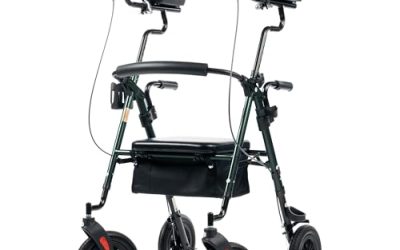
The AKOASM suits buyers whose needs change during a single outing. Its aluminium frame is rated to 450 lb, the six-level handles adjust from 33.9 to 41.3 inches for taller users, and the seat height itself adjusts across three levels from 20.7 to 23.3 inches. When walking the full distance stops being practical, detachable footrests convert it into a transport chair so a companion can push. Eight-inch non-pneumatic all-terrain tyres remove puncture worries, the three-mode brakes add control on slopes, and an under-seat bag plus cup and cane holders keep daily essentials within reach.
Specs
- Frame material: aluminium
- Weight capacity: 450 lb
- Handle height adjustment: 6 levels, 33.9 to 41.3 inches
- Seat height adjustment: 3 levels, 20.7 to 23.3 inches
- Seat depth: 15.4 inches
- Seat width: 17 inches
- Tyres: 8-inch non-pneumatic all-terrain
- Brakes: 3 modes (Free, Slow, Stop)
- Converts to a transport chair with detachable footrests
- Storage: under-seat bag, cup holder and cane holder
- Product weight: 29.8 lb
- Models: KLD1010, KLD1011, KLD1018
Best for: Taller users and anyone who wants one device that works as a rollator and, when needed, a transport chair.
Watch out for: Availability signals for this listing have been inconsistent, so confirm a live featured offer for the exact ASIN before ordering, and make sure the offer is the purple variant tied to this ASIN rather than another colour listing.
Which One Fits Your Situation
You want the strongest frame for daily walking
Choose the Medline. Its 500 lb rating gives the most headroom in this pair, the steel frame is built for constant leaning and sitting loads, and the wide 23.5-inch span between the handles keeps your stride uncramped. The padded seat and backrest make planned rest stops comfortable, and the folding frame still stores in a corner or car boot between outings.
You are tall and standard handles sit too low
Choose the AKOASM. Its grips rise to 41.3 inches, well beyond the Medline’s 37.5-inch ceiling, so taller users can walk upright instead of hunching over handles that stop short. Six adjustment levels make it easier to land exactly on your wrist line, and the three seat-height settings let you match the seat to your leg length for easier standing.
Some trips end with someone pushing you
Choose the AKOASM again. Long hospital corridors, airports and shopping centres often outlast walking stamina, and the detachable footrests turn this rollator into a transport chair in moments. A companion can push while you ride with your bag stored under the seat, then you walk again for the shorter stretches where you feel able.
You mostly walk indoors at home
Either model works, but measure first. Both are wide bariatric frames, so compare their footprints with your hallway turns and bathroom doorway before deciding. The Medline’s roughly 25 lb weight makes it the easier of the two to lift into a car, while the AKOASM’s non-pneumatic tyres shrug off thresholds and garden paths if your indoor routine includes a patio or driveway.
Common Mistakes
- Buying a standard 300 lb rollator because it looks similar, then discovering the frame flexes and the seat feels precarious under a heavier user.
- Guessing handle height instead of measuring your wrist crease, which leaves you walking stooped or with raised shoulders and aching arms.
- Ignoring the width between the handles, so hips brush the frame with every step and the rollator gets abandoned at home.
- Forgetting to measure doorways and the bathroom entrance before ordering a wide bariatric frame.
- Treating a transport-chair conversion as a full wheelchair substitute, when it is meant for a companion to push over limited distances only.
Frequently Asked Questions
What makes a rollator bariatric rather than standard?
A bariatric rollator is built around a reinforced frame with a much higher weight rating, typically 450 lb or more, compared with around 300 lb for standard models. It also runs wider between the handles, uses a broader and sturdier seat, and fits stronger wheels and brakes, so the whole device stays stable when a heavier user leans on it, sits down or stands up.
How do I set the handle height correctly?
Stand upright in your walking shoes with your arms relaxed at your sides. Adjust the grips until they line up with the crease of your wrist, which leaves your elbows slightly bent as you hold on. Both rollators adjust across several inches, so set them on a level floor, walk a short distance, and fine-tune one notch at a time until your shoulders stay down and your back is straight.
Can a rollator transport chair replace a wheelchair?
No. The conversion is designed for short stretches where a companion pushes you, such as a clinic corridor or the walk from a car park to an entrance. The small wheels, footrest position and brake setup are not built for full-day seated use or for self-propelling. If most of your mobility is seated, a dedicated wheelchair or a proper transport chair is the safer purchase.
Will a wide bariatric rollator fit through my doors?
It depends on your narrowest doorway, which is often the bathroom. Measure the clear opening with the door fully open, then compare it with the rollator’s overall width on the listing before you order. Most bariatric frames pass standard interior doors but can struggle with older, narrower bathroom entrances, so checking first avoids a return and keeps the rollator usable in the room where support matters most.