Our Short List of 3

- Best for: Brushed 1/10 crawler builds where smooth low-speed control and a strong adjustable drag brake matter most.
- Continuous current 80A, peak current 400A
- Battery input 2-3S LiPo or 5-9 cell NiMH
- Brushed motors, 540 and 550 size
- Switchable BEC output 6V, 7.4V, or 8.4V

- Best for: Brushless 1/10 crawlers up to 4S where a compact controller with strong low-speed torque and a powerful BEC is needed.
- Continuous current 80A, battery input up to 4S LiPo
- Brushless motors, designed for 1/10 scale crawling
- Compact size 36 by 30 by 15.5 mm
- High-voltage BEC up to 11A output current

- Best for: Heavy 1/10 trail rigs and 4S builds that need current headroom and a strong BEC for a high-torque servo.
- Continuous current 120A, peak current 760A
- Battery input 2-4S LiPo
- Sensorless or sensored brushless motors, sensorless mode only
- Switch-mode BEC 6V or 7.4V adjustable, 5A continuous, 10A peak
All 4 Picks at a Glance
| Product | Specs | Action |
|---|---|---|
| Hobbywing QuicRun WP 1080 G2 Brushed ESC |
| Check price on Amazon |
| Hobbywing QuicRun WP 10BL80 G2 Crawler ESC |
| Check price on Amazon |
| Hobbywing QuicRun WP 10BL120 G2 Brushless ESC |
| Check price on Amazon |
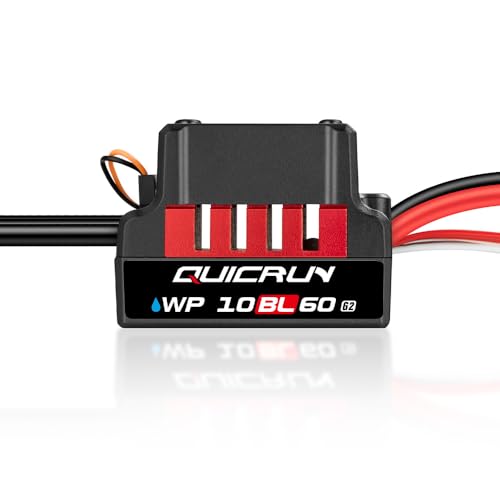 Hobbywing QuicRun WP 10BL60 G2 Brushless ESC |
| Check price on Amazon |
Key takeaways
- Compare the best ESCs for RC crawlers, from brushed crawler controllers to waterproof brushless units, with drag brake, BEC and voltage guidance.
The electronic speed controller decides how a crawler behaves on rock, and the wrong one shows up fast: a weak drag brake lets the rig roll backward on a slope, a sensorless brushless unit stutters at walking pace, and a small BEC browns out the steering servo right when the front wheels need torque. The real decision is not the biggest amp number on the box. It is matching the controller to the motor type, the battery, and the way the truck is driven, because a brushed crawler and a 4S brushless trail rig ask for different hardware.
This article covers four speed controllers for 1/10 scale crawlers, chosen from names and specifications on Amazon product pages. Two are built specifically for crawling, with drag brake tuning made for slow technical driving, and two are waterproof brushless units that crawler builders commonly fit to trail rigs. Each pick states its current rating, battery range, BEC output, and the trade-off that matters before buying.
Quick Picks
As an Amazon Associate we earn from qualifying purchases
| Product | Best for | Key spec from title |
|---|---|---|
| Hobbywing QuicRun WP 1080 G2 Brushed ESC | Brushed 1/10 crawlers on 2-3S | 80A brushed, 2-3S, waterproof |
| Hobbywing QuicRun WP 10BL80 G2 Crawler ESC | Brushless crawling up to 4S | 80A brushless, 4S, IP67 |
| Hobbywing QuicRun WP 10BL120 G2 Brushless ESC | Heavy 1/10 rigs needing headroom | 120A brushless, 2-4S, waterproof |
| Hobbywing QuicRun WP 10BL60 G2 Brushless ESC | Budget brushless trail builds | 60A brushless, 2-3S, waterproof |
How to Choose
Brushed or brushless first
The motor type decides the controller, because a brushed ESC cannot drive a brushless motor and a brushless ESC cannot drive a brushed one. Brushed setups stay popular in crawlers for their smooth low-speed feel and simple wiring, and the WP 1080 G2 is built around that style with a dedicated crawler mode. Brushless setups bring more efficiency and less maintenance, but sensorless brushless controllers can cog or stutter when starting under load on a steep rock face. A sensored brushless motor paired with a sensored controller solves that. Choose brushed for the smoothest crawl on a budget, and brushless for efficiency and power.
Drag brake strength and low-speed control
A crawler spends most of its time at walking pace, so the drag brake matters more than top speed. The drag brake holds the truck still on a slope when the throttle returns to neutral. Look for adjustable drag brake force with several levels, plus a rate setting that controls how quickly the hold applies. The WP 1080 G2 offers nine drag brake levels and real-time adjustment from an open receiver channel, while the WP 10BL80 G2 supports auxiliary channel control of drag brake force. Avoid controllers with a fixed drag brake or none at all, because holding position on rock is the core job.
BEC output for the steering servo
The built-in BEC powers the receiver and steering servo from the main battery, and crawlers punish weak ones because a high-torque servo draws hard current while the wheels are wedged against rock. A 3A BEC suits standard servos, but a heavy 1/10 rig with a strong metal-gear servo wants 5A or more, ideally with a selectable output voltage of 7.4V for high-voltage servos. The WP 10BL80 G2 provides up to 11A from its high-voltage BEC, the WP 10BL120 G2 supplies 5A continuous at 6V or 7.4V, and the WP 1080 G2 offers a switchable 6V, 7.4V, or 8.4V output.
Battery range, waterproofing, and fit
Crawlers run through mud, streams, and dust, so waterproofing is not optional for a trail truck. All four picks here carry waterproof or IP67-rated protection, which means sealed cases that handle splashes and wet trails, though none are meant to sit submerged for long. Match the battery range to the packs already owned: the brushed and 60A brushless picks run 2-3S, the 120A unit runs 2-4S, and the crawler brushless unit runs up to 4S. Measure the chassis space too, because the 120A unit is the largest here at 52.8 by 39.8 by 38.2 mm, while the crawler brushless unit is a compact 36 by 30 by 15.5 mm that fits tight scale builds.
The 4 Best Options
Hobbywing QuicRun WP 1080 G2 Brushed ESC
- Best for: Brushed 1/10 crawler builds where smooth low-speed control and a strong adjustable drag brake matter most.
- Continuous current 80A, peak current 400A
- Battery input 2-3S LiPo or 5-9 cell NiMH
- Brushed motors, 540 and 550 size
- Switchable BEC output 6V, 7.4V, or 8.4V
Brushed 1/10 crawler builds where smooth low-speed control and a strong adjustable drag brake matter most.
Brushed motors only, so it cannot drive a brushless motor. The original WP 1080 (model 30112750) is discontinued, so confirm the listing is the G2 version, model 30120202, before ordering.
This is the default brushed crawler controller, and it earns that spot with tuning made for slow technical driving rather than speed. Four running modes include a real car mode that switches motor direction in real time from an idle receiver channel, and the drag brake force adjusts on the fly the same way. Fifteen programmable parameters cover PWM frequency from 1K to 16K, freewheeling, and nine drag brake levels, so the throttle response can be shaped to the truck and the terrain. The waterproof and dust-proof case suits all-weather trail runs, and the built-in capacitor module keeps the power delivery steady.
Watch out for: Brushed motors only, so it cannot drive a brushless motor. The original WP 1080 (model 30112750) is discontinued, so confirm the listing is the G2 version, model 30120202, before ordering.
Hobbywing QuicRun WP 10BL80 G2 Crawler ESC
- Best for: Brushless 1/10 crawlers up to 4S where a compact controller with strong low-speed torque and a powerful BEC is needed.
- Continuous current 80A, battery input up to 4S LiPo
- Brushless motors, designed for 1/10 scale crawling
- Compact size 36 by 30 by 15.5 mm
- High-voltage BEC up to 11A output current
Brushless 1/10 crawlers up to 4S where a compact controller with strong low-speed torque and a powerful BEC is needed.
This is a sensorless brushless unit, so expect some cogging at very low speed under load compared with a sensored setup. Confirm the listing is the G2 Crawler version, not the 10BL80 combo that bundles a motor.
This is the brushless controller built specifically for crawling, and it is the only brushless pick here designed around low-speed torque rather than general 1/10 car use. Despite compact dimensions of 36 by 30 by 15.5 mm, it delivers 80A output on up to 4S, with strong low-speed torque and a low startup speed for technical sections. The auxiliary channel controls drag brake force from the transmitter, so the hold can be tuned while driving. Its high-voltage BEC supplies up to 11A with selectable 6V, 7.4V, or 8.4V output, which covers demanding high-torque steering servos without a separate regulator.
Watch out for: This is a sensorless brushless unit, so expect some cogging at very low speed under load compared with a sensored setup. Confirm the listing is the G2 Crawler version, not the 10BL80 combo that bundles a motor.
Hobbywing QuicRun WP 10BL120 G2 Brushless ESC
- Best for: Heavy 1/10 trail rigs and 4S builds that need current headroom and a strong BEC for a high-torque servo.
- Continuous current 120A, peak current 760A
- Battery input 2-4S LiPo
- Sensorless or sensored brushless motors, sensorless mode only
- Switch-mode BEC 6V or 7.4V adjustable, 5A continuous, 10A peak
Heavy 1/10 trail rigs and 4S builds that need current headroom and a strong BEC for a high-torque servo.
It runs sensored motors in sensorless mode only, so low-speed starts can cog under load. The sensored 10BL120 G2 is a different non-waterproof listing, so confirm the WP waterproof version before ordering.
This 120A unit is the headroom pick for heavier 1/10 rigs and 4S trail builds, with far more continuous current than the other brushless options here. It runs sensorless and sensored brushless motors in sensorless mode only, on 2-4S LiPo, with motor limits of 6000 KV on 2S for a 3652-size motor, 4000 KV on 3S for a 3660-size motor, and 2600 KV on 4S for a 4268-size motor. The switch-mode BEC delivers 5A continuous and 10A peak at 6V or 7.4V, and a built-in fan powered by the BEC keeps temperatures in check. The IP67-rated waterproof case and 1640uF built-in capacitor suit wet trail conditions.
Watch out for: It runs sensored motors in sensorless mode only, so low-speed starts can cog under load. The sensored 10BL120 G2 is a different non-waterproof listing, so confirm the WP waterproof version before ordering.
Hobbywing QuicRun WP 10BL60 G2 Brushless ESC
- Best for: Budget brushless trail builds on 2-3S where a compact waterproof controller and a modest servo load are enough.
- Continuous current 60A, peak current 360A
- Battery input 2-3S LiPo
- Sensorless brushless motors
- BEC output 6V at 3A
Budget brushless trail builds on 2-3S where a compact waterproof controller and a modest servo load are enough.
Sensorless only, so low-speed starts under load can cog, and the 3A BEC is modest for a big high-torque servo. Keep motors under about 6000 KV on 2S and 3500 KV on 3S.
This 60A unit is the budget route into brushless power for a lighter trail rig, with a compact G2 case, a mesh heat sink with copper thermal bars, and a fan included. It drives sensorless brushless motors on 2-3S, with a 6V and 3A BEC and full waterproofing, so it handles wet trails without extra sealing. The G2 version is shorter and narrower than the original 10BL60, which helps in tight chassis layouts. Intelligent freewheeling keeps efficiency up and temperatures down, and the forward, brake, and reverse modes cover normal trail driving.
Watch out for: Sensorless only, so low-speed starts under load can cog, and the 3A BEC is modest for a big high-torque servo. Keep motors under about 6000 KV on 2S and 3500 KV on 3S.
Which One Fits Your Situation
Running a brushed motor in a 1/10 crawler
Pick the Hobbywing QuicRun WP 1080 G2 Brushed ESC. It is the only brushed controller here, and its nine-level drag brake, real-time drag brake adjustment, and fifteen programmable parameters are built for slow technical driving. The switchable BEC covers standard and high-voltage servos, and the waterproof case handles wet trails. Confirm the listing shows model 30120202, since the original WP 1080 is discontinued.
Building a brushless crawler for technical rock work
Pick the Hobbywing QuicRun WP 10BL80 G2 Crawler ESC. It is the only brushless pick designed for crawling, with strong low-speed torque, a low startup speed, and auxiliary channel drag brake control. The 11A BEC drives a demanding steering servo, and the compact 36 by 30 by 15.5 mm case fits tight scale chassis. Accept some sensorless cogging at the slowest speeds under load.
Running a heavy rig or 4S packs
Pick the Hobbywing QuicRun WP 10BL120 G2 Brushless ESC. Its 120A continuous rating and 2-4S input give the headroom a heavy 1/10 rig needs, and the 5A BEC at 6V or 7.4V powers a strong servo. Check the motor KV limits for the battery count, since 4S caps at 2600 KV for a 4268-size motor, and remember it runs sensored motors in sensorless mode only.
Upgrading a light trail truck to brushless on a budget
Pick the Hobbywing QuicRun WP 10BL60 G2 Brushless ESC. Its 60A rating, waterproof case, and included fan cover a light 2-3S trail build at a lower cost than the bigger brushless units. Keep the motor within the KV limits and the servo modest, because the 3A BEC will not feed a large high-torque servo, and expect some sensorless cogging at crawl speed.
Common Mistakes
- Buying a brushless ESC for a brushed motor, or the reverse, because the two motor types need different controllers and are not interchangeable.
- Ignoring the BEC rating and fitting a high-torque servo that draws more current than the built-in BEC can supply, which causes brownouts while steering under load.
- Choosing a sensorless brushless ESC for technical rock crawling and expecting the smooth low-speed starts of a sensored setup.
- Running a 4S pack on a 2-3S controller, which damages the ESC on the first voltage spike.
- Ordering the wrong generation or variant, such as the discontinued original WP 1080 instead of the G2, or the non-waterproof sensored 10BL120 instead of the WP version.
Frequently Asked Questions
What is the best ESC for a brushed RC crawler?
The Hobbywing QuicRun WP 1080 G2 Brushed ESC is the strongest brushed pick for 1/10 crawlers. It offers 80A continuous current, a nine-level drag brake with real-time adjustment, fifteen programmable parameters, and a switchable 6V, 7.4V, or 8.4V BEC in a waterproof case. It suits 540 and 550 brushed motors on 2-3S, and the real car mode adds direction switching from an idle receiver channel.
Can a sensorless brushless ESC work for rock crawling?
Yes, but with a trade-off at very low speed. Sensorless brushless controllers can cog or stutter when starting under load on a steep section, because they lack hall sensor feedback at standstill. The WP 10BL80 G2 Crawler is built to reduce that with strong low-speed torque and a low startup speed.
How strong should the BEC be for a crawler?
A 3A BEC suits standard servos, but a heavy 1/10 rig with a high-torque metal-gear servo needs 5A or more. The WP 10BL80 G2 supplies up to 11A, the WP 10BL120 G2 supplies 5A continuous at 6V or 7.4V, and the WP 1080 G2 offers a switchable 6V, 7.4V, or 8.4V output. Check the servo current draw first, and add a separate BEC if the built-in one falls short.
Are waterproof ESCs safe to run through water?
Waterproof and IP67-rated controllers handle splashes, mud, and wet trails, and all four picks here carry that protection. None are meant to sit submerged for long, and the protection can decline as seals age, so rinse the truck with fresh water after a muddy run and let it dry fully. Remove or protect any cooling fan before deep water, since fans are not always sealed the same way.